


- Home
- Companies
- Ultrawaves Wasser & Umwelttechnologien ...
- Products
- ULTRAWAVES - Model Biosonator - ...
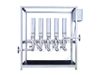
ULTRAWAVES - Model Biosonator -High-performance Ultrasonic System
The efficient ultrasonic unit was developed as a plug & play system to test initial trial runs at wastewater treatment plants before the purchase decision is made. Before municipal and industrial wastewater treatment plant operators decide to use ultrasonic to treat their sewage sludge, even in the long term, the technology is usually tested in advance for several months. In order to now offer operators an even more practical and, above all, optimized solution, ULTRAWAVES, in cooperation with its colleagues from SONOTRONIC, has further developed the ultrasonic system into a plug & play system, the BIOSONATOR.
Because the peripherals, consisting of pump, pipework and flowmeter, are incorporated into the BIOSONATOR compact and are ideally matched to the ultrasonic unit, the technology can, from now on, be simply and directly integrated into current plant operation. The operator does not have to purchase any further equipment for the trial run, thereby saving time and cost.
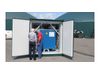
Another significant advantage is that the ultrasonic system can be fitted with 100 % compatible components by our service engineers in less than one day and will demonstrate maximum effect even during the test phase. As the BIOSONATOR compact is divided up into three linked platforms (pump, ultrasonic system and switch cabinet), it is also simple to install in any room and is very easy to operate.
Ultrasonic disintegration has many applications at wastewater treatment plants
Ultrasonication can be used at many different layers in sewage treatment plants. Depending on the application, thickened excess or return sludge is exposed to ultrasonic waves, thereby bringing about, for example, increased biogas production, reduced amounts of residual sludge for disposal, reduced digestion time or even the rectification of operating problems. The positive effects of ultrasonic are established within a few weeks with the BIOSONATOR.
- Biogas plants
- Renewable raw materials plants
- Waste fermentation plants
- Cofermenter plants
- Plants with dry matter up to max. 15 %
- Wastewater treatment plants
- Maximization of the biogas quantity
- Reduction of viscosity
- Stabilization of the biology
- Extending the life of agitators and pumps
- Reduction of disposal quantities and costs
- Increase of gas production, up to 20 %
- Increase of methane content in biogas
- Savings in feeding
- Improvement of flow properties
- Substitution with cheaper substrates
- Reduction of disposal costs
- Reduction of own power demand
- Improvement of bioavailability
- Intensification of fermentation
- Increase of biogas production
- Savings in the purchase of substrates
- Feeding of alternative, rough, fibrous substrates
- Reduction of fermentation residues
- Improvement of bioavailability in wastewater treatment plants and biogas plants
- Increase of biogas production
- Savings in the purchase of substrates
- Feeding of alternative, rough, fibrous substrates
- Reduction of fermentation residues
New design with variable number of modules
The patented ULTRAWAVES high-power ultrasonic systems have a compact design, and they increase efficiency in the production of environmentally friendly energy. Therefore, they can be easily and simply integrated into existing plants.
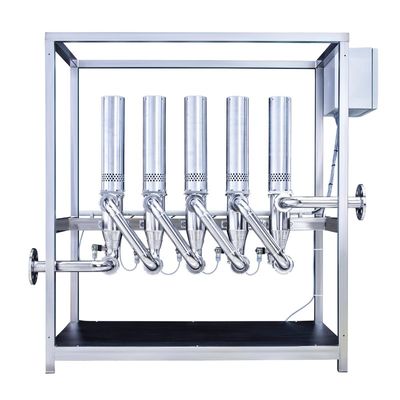
In the high-power ultrasonic system, the biomass strikes the front of the sonotrodes from left to right and is guided past them in loops. On the one hand, this prevents deposits within the individual chambers. On the other hand, the vibrating structures can work more efficiently and need less maintenance because the biomass does not adhere to the sonotrode tips. Thanks to the modular design, the new high-power ultrasonic system can be flexibly adapted to the size of the system. As a rule, it consists of three to five consecutively arranged modules – depending on the volume flow that is to be treated.
As the medium itself only dwells in the ultrasonic system for a short time, the unit has a very compact size. It can be easily integrated into existing plants via an inlet and outlet pipe, without any complications (plug & play).
- Dimensions (l*w*h) [mm] : 1,330 * 750 * 1,500
- Weight [kg] : 120
- Volume [m³] : 0.030
- Connected load [kW] : 5
- Material : V2A steel