


- Home
- Companies
- Utah Shelter Systems
- Products
- Underground Steel Shelters
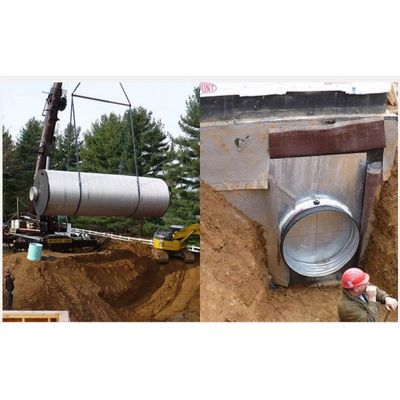
Underground Steel Shelters
Utah Shelter Systems specializes in manufacturing underground steel shelters because they offer very cost effective protection from the effects of nuclear weapons, as well as biological and chemical weapons (NBC). That ordinary citizens can be so effectively protected to within 1/2 mile of a large yield nuclear explosion for about the cost of a new pickup truck is remarkable. The concept is simple. A steel cylinder of a usable size is outfitted with bulkheads, a deck, electrical system, ventilation system, and properly designed entrances, and buried to a suitable depth to ensure proper earth arching and shielding. If the wall thickness of the cylinder is thick enough, and the backfill is performed to industry specifications, such a structure will endure a nuclear shock that would destroy all above ground buildings within a 5-mile radius of the blast.
The overall design of our underground steel shelter provides protection from blast, earth movement, fire, radiation, EMP and chemical and biological war gasses. This is accomplished through careful engineering and design of the shelter body, doors, air filtration systems; and the geometry of the entrances and the installation process.
Corrugated steel pipe (CSP) shelters were tested and proven at the Nevada test site to blast pressures of 200 psi. In order to achieve protection to that level, the shelter must have an arched ceiling and the dirt cover over the shelter chamber must be equal to or greater than the diameter of the shelter. At this depth, `earth arching` is achieved. Care must be taken to properly match the gauge of the steel to the shelter diameter. Eight-foot shelters are built of the proper gauge to be placed into a 16-foot hole and to safely withstand the burden of 8 feet of dirt cover plus the additional overpressure of 200 pounds per square inch of air blast. Nine-foot shelters will reach this level of protection in an 18-foot hole. Ten-foot shelters are designed to be placed into a 20-foot hole with 10 feet of cover. Flat roofed steel shelters will not withstand these heavy over burdens because they cannot achieve "earth arching". They will fail catastrophically under these overpressure loads.
The thermal pulse from a nuclear weapon will not penetrate through the dirt cover, into the interior of the shelter. The pulse, however, can oblate steel from the outside door, if the shelter is near the area of detonation. When shelters are located near nuclear targets, a sacrificial cover is provided for placement over the steel hatch door.