


- Home
- Companies
- Unidata Pty Ltd
- Products
- Unidata Neon - Model M Series - Remote ...
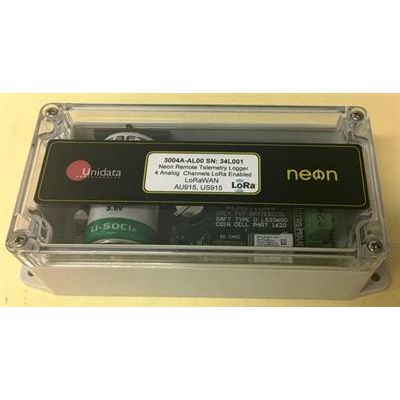
Unidata Neon - Model M Series -Remote Logger
Four and six Channel M Series Neon Remote Loggers are smaller form factor NRL dataloggers, housed in a polycarbonate case. The 3004M and 3006M Neon Remote Loggers connects to sensors in the field, collects readings from those sensors, logs the sensor data, provides control functions and also transmits the collected data to a central server. The 3004M/3006M Neon Remote Logger is programmed in the field with a Unidata standard program called a scheme. The scheme specifies how often and for how long the datalogger should collect data from the sensors and how often the data should be sent to the server. Control outputs are also set up in the scheme by setting up custom events.
A wide range of sensor types are supported, for example, analog; including 4-20mA sensors, frequency counters, digital inputs as well as Modbus and SDI-12. Control of external equipment (such as triggering a relay when a user defined event occurs, or initiating a shutdown), can be accomplished via Open Drain FET output. Sensors are connected to the logger via pluggable terminal blocks, allowing for easy removal of the logger if servicing is required.
The 3004M/3006M Neon Remote Loggers utilise different wireless networks as their method of sending sensor data from the field to the Neon Server for example 3004MC and 3006MC uses cellular 2G, 3G, 4G or LTE phone network while 3004ME and 3006M uses Ethernet network.
3004ML LoRa WAN datalogger utilises the LoRa communication system, LoRa WAN network, which utilises MQTT as its method of sending sensor data from the field to the Neon Server. The NRL LoRa operates in what Unidata calls LoRa Mode 2. In this mode, sensors are read by the logger according to the scheme. A set of short data packets will be sent, as set by logging interval, to the LoRa WAN gateway over either private or public LoRa network. LoRa WAN gateway transfers data packets to Neon Server using Ethernet, cellular or satellite network. The LoRa Wan system has a typical range of to 5 Km, the range reduces in built up areas depending on building density and increases where there is line of sight and with use of a larger antenna.
3004MH and 3006MH – Microsatellite datalogger makesuse of a microsatellite network as their method of sending sensor data from the field to the Neon Server. The microsatellite network is a message based system, providing low cost satellite communications over a high latency service. This low cost service is ideal if you have a requirement for occasional short messages to report sensor data, when the latency of the messages is not very important. Latency from such systems is in the order of hours and the very low satellite airtime costs reflect this high latency service.
3004MI and 3006MI – Iridium SBD datalogger take advantage of the high reliability Iridium satellite network short burst data subsystem. It is a high reliability message based system, providing reasonable cost satellite communications and a low latency. This service is ideal if you have a requirement for short messages to report sensor data. Latency from such systems is in the order of minutes and the satellite airtime costs reflect this low latency service.
Any Neon Remote Logger from 3004M and 3006M range can be housed in an aluminium IP68 rated enclosure. When high standard water protection is required, Unidata M series Neon Remote Loggers can be housed in a rugged die cast IP68 rated aluminium enclosure. Selected enclosure satisfies the requirements of IEC60529 IP68 conditions – being submerged under more than 1m of water for 24 hours without any water ingress.
Enclosure is powder coated for extra corrosion protection and equipped with a circular 8 way IP68 stainless steel connector. Matching IP68 stainless steel connector is either assembled onto sensor, if available, or provided for customer to use.
The 3001M Nano Logger was designed for use in boreholes of 100mm internal diameter and above but it can be used whenever a smaller form factor is logger is required. It can be configured to use ether Cellular, Iridium SBD or LoRa networks as its method of sending sensor data from the field to the Neon Server.
The 3001M Nano Logger connects to sensors in the field, collects readings from those sensors, logs the sensor data and transmits the collected data to a central server via a Cellular, LoRa or Satellite network.
The 3001M Nano Logger is programmed in the field with a Unidata standard program called a scheme. The scheme specifies how often and for how long the datalogger should collect data from the sensors and how often the data should be sent to the server. A wide range of sensor types are supported, for example, analog sensor, frequency counter, digital input as well as Modbus and SDI-12.
The 3001M NRL Nano Logger comes with 2 x D cell Lithium batteries.
The 3901A Battery extender can be used to add additional lithium battery capacity to the 3001 Neon Remote Logger. Depending on the application, the scan rate, the log rate and the communications rate, this battery extender allows for up to 10 years of operation for the 3001 NRL.
Sensors are connected to the logger via a custom specified connector, allowing for easy removal of the logger if servicing is required.
- Storage memory: 7.5Mbytes Flash (non-volatile), 3.75 Million log data points
- Memory expansion: SD card, micro size, 32Gbyte maximum capacity, 16 Billion log data points
- Scan rate: Programmable from 1 second to 5 minutes
- Log rate: Programmable from 1 second to 24 hours
- Time clock:
- Battery Backed Real Time Clock (RTC),
- Accuracy +/- 10 seconds/month (non- Neon version),
- locked to server time clock (Neon version)
- CPU: 16 Bit, 20MHz, Ultra Low Power
SPECIFICATIONS 3004M AND 3006MPHYSICAL SPECIFICATIONS
- Material: Polycarbonate
- Size: 190mm x 80mm x 55mm (LxWxH), 300g
- Operating Temperature: -20° to +60°C. Not affected by humidity
- Antennae: Model dependant, external stub/whip/satellite antenna
ELECTRICAL SPECIFICATIONS
- External Power: 9 to 30V DC
- Current Draw: 50µA Standby
- RTC Backup Battery: 3.6V Li Coin Cell (5 year life)
- Internal Power: 3.6 Volt Lithium D Cell
- Instrument Power: 5V or 12V or 18V regulated, 80mA (user selectable)
- Instrument Reference Voltage: 5V 10mA Max
- Analog channels 3004M: 4, Single ended (max) or 2 Differential (max),
- Analog channels 3006M: 6, Single ended (max) or 3 Differential (max),
- 24 bit resolution, 4 user selectable gain ranges
- 0 to 5000mV (gain=1) to 0 to 39mV (gain=128)
- Modbus: 1 independent channel, RS485,
- RTU or ASCII protocol, 57600 baud (max),
- functions 01, 02, 03, 04, 05/15, 06/16
- SDI-12: 1 independent channel, SDI interface, 16 channels, bi-directional
- Counters 3004M: 4,
- 2 x 16 bit, DC to 20kHz potential free contacts or 0 to 5V DC digital input (C0,C2);
- 2 x 16 bit, dc to 300Hz potential free contacts or 0 to 5V DC digital input (C1,C3)
- Counters 3006M: 2,
- 1 x 16 bit, DC to 20kHz potential free contacts or 0 to 5V DC digital input (C0);
- 1 x 16 bit, dc to 300Hz potential free contacts or 0 to 5V DC digital input (C1)
- Unidata HSIO: High speed serial interface
- Digital Outputs: 1 Open Drain FET, 30V DC, 250mA max
- Configuration Port: USB B Micro Port and SD Micro Card
- Modem Options:
- 3004MC/3006MC – 2G, 3G 4G and LTE Cellular Modem
- 3004ML – LoRa – AU915 or US915 or EU868 or AS923
- 3004MH/3006MH – Microsatellite
- 3004MI/3006MI – Iridium Short Burst Data
- Accelerometer: Senses changes in logger orientation
- Barometer: 260-1260hPa Absolute Digital Output
SPECIFICATIONS 3001MPHYSICAL SPECIFICATIONS
- Material: Polycarbonate
- Size: 120mm x 80mm x 72mm (LxWxH), 300g
- Operating Temperature: -20° to +60°C. Not affected by humidity
- Antennae: Model dependant, external stub/whip/satellite antenna
- ELECTRICAL SPECIFICATIONS
- External Power: 9 to 30V DC
- Current Draw: 50µA Standby
- RTC Backup Battery: 3.6V Li Coin Cell (5 year life)
- Internal Power: 3.6 Volt Lithium D Cell x 2
- Instrument Power: 15V or 18V regulated, 80mA (user selectable)
- Analog channels: 1 Single ended (0-2.5V) with 12 bit resolution
- Modbus: 1 independent channel, RS485,
- RTU or ASCII protocol, 57600 baud (max),
- functions 01, 02, 03, 04, 05/15, 06/16
- SDI-12: 1 independent channel, SDI interface, 16 channels, bi-directional
- Counters: 1
- 1 x 16 bit, DC to 20kHz potential free contacts or 0 to 5V DC digital input (C0)
- Configuration Port: USB B Micro Port and SD Micro Card
- Operating Frequencies:
- Option C – 2G, 3G 4G and LTE Cellular Networks
- Option L – LoRa – AU915 or US915 or EU868 or AS923
- Option H – Microsatellite 500MHz
- Option I – Iridium SBD – 1.5GHz
- Barometer: 260-1260hPa Absolute Digital Output Barometer