


- Home
- Companies
- UV Light Technology Limited
- Products
- UV-C Irradiance Meter
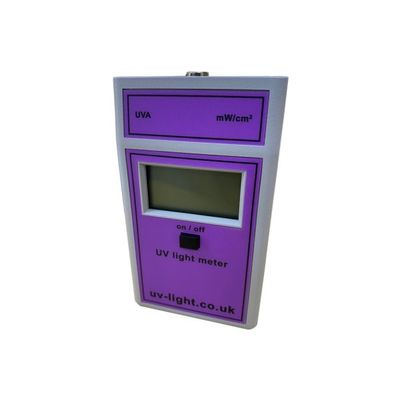
UV-C Irradiance Meter
NIST traceable, hand-held UV light irradiance meter with an integral sensor. Compact and durable for single-handed use.
- Measure UV in the wavelength range of 246nm – 268nm
- Measurements are shown in mW/cm2
- Supplied with certificate of calibration
Typical applications include monitoring drop off of UV bulbs and tubes and transmission testing of PPE, screens and guards.
Applications
- Measurement of UV-C irradiation level to determine the time to achieve a dose necessary to inactivate (kill) specified micro-organisms.
- Monitoring drop off of UV-C light irradiance during the operating life of UV-C germicidal bulbs and tubes.
Sensor
The sensor consists of a Silicon Carbide (SIC) photodiode chip and a UV filter. It is completely insensitive to UV and visible light longer than 280nm and infrared radiation. The meter’s spectral response only covers the UV region from 245 – 270nm.
Operation
To operate your UV meter, aim the sensor window located on the top panel of the meter directly at a UV source. Press and hold push-button switch on the face of the unit. Aim sensor window in the top panel of meter directly at UV source. Note reading on LCD and record if required.
The battery operation voltage is 9V down to 6.5V. Below 6.5V the LCD numbers will begin to dim, indicating the need for a battery replacement. Under “typical” service load, the battery should last about 2 years.
- Wear eye and skin protection when checking UV lamps (a face shield that provides wrap-around protection is ideal).
- Allow lamps to warm-up prior to taking readings (at least 5 minutes).
Additional information
- When comparing different types of lamps consider readings to be relative rather than absolute.
- Lamps that peak near 255 nm (newer designs) will read higher than lamps that peak near 265 nm.
- Do not subject the meter to extremes in temperature, humidity, shock or dust.
- Use a dry, soft cloth to clean the instrument. Keep the sensor free of oil, dirt, etc.