


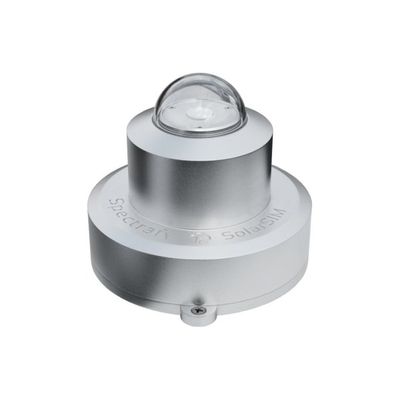
Spectrafy - Model SolarSIM-UV -UV Irradiance Sensor
The SolarSIM-UV brings our SolarSIM technology to bear on the challenge of solar UV measurement. The result is a UV sensor like no other.
The SolarSIM-UV uses multi-spectral measurement to accurately resolve the solar spectral irradiance over the full UV range. From this, all the UV components are then precisely extracted.
- Measurands: UV-Total, UV-A, UV-B, UV-E, UV index, PAR, GHI
- Technology: Software-augmented multi-filter radiometer.
- Highlights: All UV components from a single sensor. UV spectral and total irradiances.
Measuring solar UV irradiance is tough. The SolarSIM-UV rises to the challenge through the use of multi-spectral measurement. The result is a robust, accurate UV sensor unlike anything else.
The SolarSIM-UV uses filtered photodiodes to make precise, multi-spectral measurements of the solar spectrum in several narrow wavelength bands. These measurements then inform Spectrafy’s proprietary algorithms to accurately resolve the global solar spectrum within the UV range.
The SolarSIM-UV software then automatically integrates and processes the UV spectral irradiance to provide the full suite of UV parameters, including UV-T, UV-A, UV-B, UV-E and UV index. Because the UV components are obtained directly from spectral integrals, the limitations associated with traditional UV sensors , such as imperfect filter profiles and spectral selectivity are eliminated.
This innovative approach makes the SolarSIM-UV the first, and only sensor capable of resolving all UV components at the same time, thereby greatly simplifying the sensor count required for comprehensive UV monitoring.
Applications for the SolarSIM-UV include weather forecasting, UV reporting for public health, ground truthing of climate models, agricultural monitoring and material testing.
The SolarSIM-G can generate up to 20 high-quality data streams. Choose what you need:
- Global UV spectral irradiance : Solar spectral irradiance over the 280-400nm wavelength range, with 1nm resolution.
- UV-A : Solar global irradiance within the wavelength range of 315 - 400nm.
- UV-B : Solar global irradiance within the wavelength range of 280 - 315nm.
- UV-T : Solar global irradiance within the wavelength range of 280 - 400nm.
- UV-E : UV irradiance weighted to the response of human skin, per IEC 17166.
- UV-Index : Based on UV-E, the international scale the quantifies the potential for UV irradiance to damage human skin.
- Photosynthetically active radiation : Total irradiance within the 400-700nm wavelength range.
- Meteorological parameters : Ambient temperature, relative humidity and atmospheric pressure.
Irradiance
- UV-Total : 280 – 400 nm
- UV-A : 315 - 400 nm
- UV-B : 280 - 315 nm
- UV-E : per IEC 17166
- PAR : 400 - 700 nm
- GHI : 280 - 4000 nm
- Spectral response : n/a - measurements integrated from spectra
- Response time (95%) : < 0.5 s
- Cosine response : ±3% at 80º zenith
- Non-stability (change/year) : < 0.5 %
- Non-linearity : < 0.5 %
- Temperature response : < 0.1% (in-situ temperature correction)
- Calibration uncertainty : 1.1%
- Exposure time : < 1 ms
- Max acquisition rate : 0.5 Hz
General
- Weight : 1.1 kg
- Dimensions : 132 x 132 x 110 mm
- Power supply and use : 12 VDC, <1W
- Communication : RS-485 ASCII, Direct to PC, serial over ethernet, datalogger
- Operating temperature range : -30 to 65 °C
- Humidity Range : 0 to 100% RH
The only UV sensor you`ll ever need.
- Public health : UV irradiance can significantly damage human skin, resulting in sun burn, premature ageing and even some forms of cancer. Widespread deployment of UV sensors help the public understand local UV conditions in real-time.
- Agricultural monitoring : Ultraviolet light is known to have adverse effects on plants and animals. UV measurement networks allow industry an researchers to quantify and predict the effects of naturally occurring UV light on our food chains.
- UV load monitoring for material testing : Accurately quantifying the UV exposure of new materials and coatings during outdoor testing provides important insights into their real world performance.