- Home
- Companies
- The Advanced Aeration Group, LLC
- Products
- VBT - Vacuum Bubble Technology Aeration ...
VBT - Vacuum Bubble Technology Aeration Use in Compressed Air/Fine Pore System
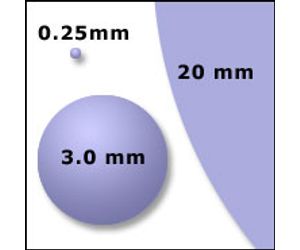
The Vacuum Bubble® Technology Aerator, instead of using the compressed air/fine pore system, uses a patented process to create bubbles in a partial vacuum. The micro Vacuum Bubbles® created in this process average 0.25 mm in diameter. The small size of the bubble and the low-pressure gas it holds create a small buoyancy force (The phenomenon which makes bubbles rise in a liquid). This buoyancy force is so small that it is less than the surrounding surface tension of the water. The bubble, in fact, does not rise to the surface, but remains suspended in the fluid. This makes all of the oxygen in the bubble available to be dissolved in the liquid as needed.
Most aeration equipment in use today utilizes compressed air systems. These introduce bubbles of air into the water by forcing the compressed air through a fine pore diffuser, similar to the aerators commonly found in most home fish tanks. Experimental results with these systems have shown that the minimum bubble sizes generated are greater than 3 to 4 millimeters in diameter. Bubbles of this size quickly rise to the surface and are lost to the atmosphere. They do not remain in the water long enough to transfer an appreciable amount of oxygen.
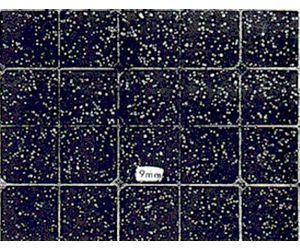
A VBT™ 100 Aerator was installed in a 55 gallon glass tank with 50 gallons of tap water. A watertight plastic rectangle large enough to hold a Polaroid camera was mounted with a clear plastic grid of 9 mm squares. The aerator was placed 24 inches below the surface of the water. The aerator plate was 2 inches in diameter and had ten 2.38 mm orifices.
As the propeller withdrew water from the 12 inch column, a partial vacuum interface formed between the plate and propeller causing water to collapse in the partial vacuum, thus forming the micro Vacuum Bubbles®. The aerator was activated for 60 seconds, shut-off and a Polaroid negative taken of the bubbles accumulated on the surface of the submerged 9 mm square grids.
Figure 1: This image was enlarged 3.1X from 3″ X 4″ film to an 8″ X 11″ photograph which was examined using a Bausch and Lomb dissecting microscope at 60X magnification. A micrometer slide with 0.01 mm scales was used to measure the diameters of 15 randomly chosen bubbles in three randomly chosen grid squares for each of three one-minute sample periods.
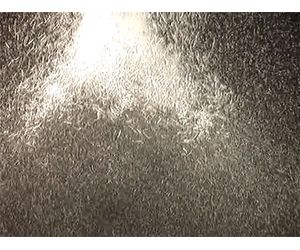
- Compressed air diffusers produce bubbles 20mm or greater in diameter.
- Fine-pore diffusers produce bubbles between 2mm and 4mm in diameter.
- VBTtm creates bubbles 0.25mm in diameter.