

- Home
- Companies
- Vandezande bvba
- Products
- Vandezande - Automatic Trash Rack
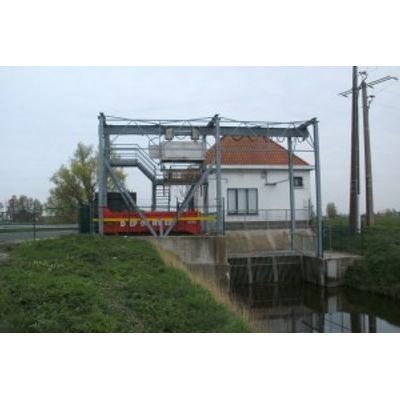
Vandezande - Automatic Trash Rack
An automatic trash rack facility is employed for removing a build- up of miscellaneous coarse debris in a canal or river by catching it in a grid structure. It is installed on the upstream side of pump stations or rivers. The debris is then collected, transported and finally deposited into a container.
An automatic trash rack facility consists of the following components:
- Depending on the width of the canal, 1 or more removable grid frames of stainless steel, equipped with vertical grid bars, are required. The distance between the grid bars can be selected. There is a choice between 40 mm or 100 mm. The grid frames are supported by guide rails, mounted at an angle of 75° in relation to the horizontal surface. The mechanical resistance of the grid frames with grid bars is calculated on a maximum height of the water upstream, without back pressure downstream.
- The stainless steel bucket consists of a fixed part and a hinged part. When cleaning, the fixed part of the bucket slides down the grid bars into the build-up of debris. The hinged part of the bucket is then closed, using 2 stainless steel hydraulic cylinders. The fixed part of the bucket is compatible with the distance between the grid bars for a smooth operation and intrusion. In standard versions, the width of the bucket varies between 1,200mm to 1,800mm.
- A moving trolley with support structure.
There are 3 different types :
Overhead transfer type: a moveable trolley is suspended from a monorail which is supported by a portal structure. The bucket is suspended from steel cables, wound round 2 cable drums.
Crane type: a trolley with hinged crane arms, moving on a track fitted with crane rails. The bucket is suspended from the end of the crane arms.
Hybrid type: a combination of the overhead transfer type and crane arm type: a trolley with fixed gallows, moving on a track fitted with crane rails. The bucket is suspended from steel cables, wound around 2 cable drums.
Overhead transfer:
- A reduction motor fitted with a brake operates the 2 cable drums of the bucket, which is suspended from steel cables.
- Idlers prevent the unwanted unwinding of the steel cables.
- A hydraulic power unit feeds the hydraulic cylinders of the bucket.
- An electronically driven hose reel controls the hydraulic TWIN hose, which powers the hydraulic cylinders of the bucket.
- The moveable trolley is suspended on runners, each of them are equipped with 2 vulcanized running wheels.
- The transfer movement on the monorail of the trolley unit is operated via a reduction motor fitted with a brake.
- All necessary sensors and limit switches are provided for monitoring the operation of the equipment.
- The frame of the trolley and the machine housing are made of stainless steel. The access hatches are equipped with gas springs.
- The steel portal structure with monorail is anchored onto the adjacent concrete structure.
Crane:
- The steel crane arm consists of a main arm and a swivel arm; the bucket is hinged at the end of the swivel arm.
- Hydraulic cylinders perform the movements of the crane arm.
- A hydraulic power unit feeds the hydraulic system.
- In this setup the crane arm is moved rotationally on a turntable fitted with a ring gear.
- The rotational movement of the crane arm and the transfer movement of the trolley is driven by a reduction motor or via a hydraulic motor.
- During the transfer of the trolley all steel wheels of the trolley are powered.
- The steel track fitted with 2 crane rails is anchored onto the adjacent concrete structure.
Hybrid:
- A reduction motor fitted with a brake operates the 2 cable drums of the bucket, which is suspended from steel cables.
- The end of the gallows has guide wheels, over which the steel cables roll.
- Idlers prevent the unwanted unwinding of the steel cables.
- A hydraulic power unit feeds the hydraulic cylinders of the bucket.
- An electronically powered hose reel controls the hydraulic TWIN hose, which powers the hydraulic cylinders of the bucket.
- In this setup the crane arm is moved rotationally on a turntable fitted with a ring gear.
- The rotational movement of the crane arm and the transfer movement of the trolley is driven by a reduction motor or via a hydraulic motor.
- During the transfer of the trolley all steel wheels of the trolley are powered.
- The steel track fitted with 2 crane rails is anchored onto the adjacent concrete structure.
For each configuration we provide the following custom engineered facilities:
- Access steps, handrails, stairs and ladders specific to the accessibility requirements and level of security.
- The installation of the monorail or track is undertaken to guarantee maximum integration with adjacent structures or to comply with legal building regulations.
- Protection of steel structures: galvanizing and painting in the desired RAL colour or hot dip galvanizing.
- Level of automation: PLC control and integration with already existing controls.