


- Home
- Companies
- ARCoptix S.A
- Products
- ARCoptix - Model VSP - Variable Spiral ...
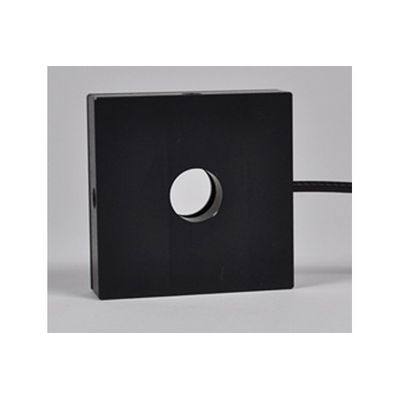
ARCoptix - Model VSP -Variable Spiral Plate for Vortex Beam Generation
The variable spiral plate (VSP) is a passive liquid crystal optical element that is capable to modify a simple laser beam into a vortex beam, radial polarized beam having orital momentum (L=1 or L=2). The VSP is a perfectly transparent optical element without scattering or diffracted ligh losses (apart from the absorption losses of the material). The conversion from homogenous linear polarized beam to, for example, radial, azimuthal (or also lemon, spiral or star distribution) can simply be obtained by placing the VSP in the optical path of your laser beam.
The different output Polarization patterns can be obtained by simply changing the bias applied on the Q-plate the VSP.
Orbital momentum or helical wavefront generation-spiral phase plate (SPP)
One interesting application of the VSP is the transformation of a planar wavefront with circular (left or right) Polarization into a beam with an optical vortex (with an undefined phase in the center of the beam). Such a beam carries an orbital momentum (OAM) and has a helical wavefront as shown in the picture below. The retardation of the Q-plate is controlled by an AC bias and can be adjusted to any wanted value between 50-1500nm. As an additional feature, the orbital momentum can switched on and off (within 100ms) simply by changing the bias on the q plate. Notice
Radial and azimuthal Polarization
As the ARCoptix radial Polarization converter product (link), the VSP (with topology q = 0.5) is capable to transform a linear input Polarization into a radial or an azimuthal Polarization (depending of the input Polarization). The same Q-plate can be adapted to any wavelength by simply adjusting an AC voltage (0-5V) that is applied on the VSP.
Spiral Phase
The variable spiral plate can produce from a simple gaussian beam with a spiral phase. To proove this, we create a well-known Mac-Zehnder interferometer setup coupled to a CDD camera to record the interference pattern at the output of the interferometer. By tilting the two beams of the interferometer, we obtain regular interference fringes (as shown in picture) and by introducing a spiral plate (with half wave retardation), we obtain a phase dislocation (pitchfork hologram). Again, if the VSP retardation is tuned (via an electric bias) to full wave retardation, the dislocation disappear as in pictures below.
- Capable to generate many different circular symmetric and continuous Polarization distributions by simply changing the bias or input Polarization
- One element works for all wavelengths from 400 to 1500nm
- Works for all types of laser also femto-second pulsed lasers
- Capable to generate Orbital momentum and helical beams
- Capable to generate radial & azimuthal Polarization distribution
- No loss, no scattering, no diffraction, no segments
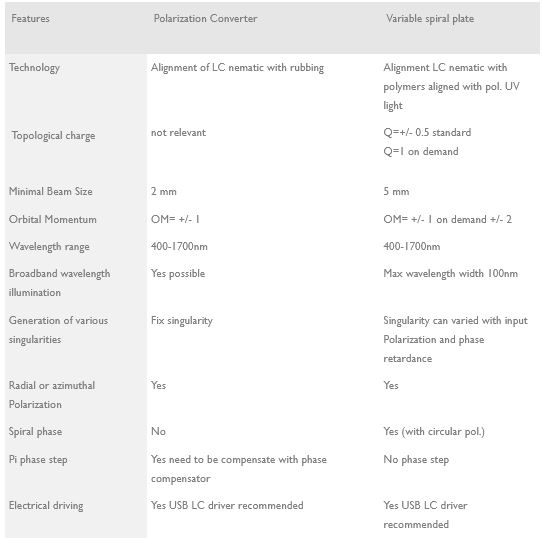
The spiral plate is a nematic liquid crystal cell composed of two polymer aligned substrates with a liquid crystal layer in between. The local alignment of the LC in the spiral plate can be structured to any desired pattern during its fabrication. Indeed, the alignment direction imprinted on the polymer layer is parallel to the Polarization of the UV light during the polymerization process. By playing on the Polarization of the incoming UV light, all kinds of alignment patterns of the liquid crystal, and hence of the optical axis, can be obtained. In the schematic, it is shown how the different alignment patterns of the Q-plates are realized. By playing on the rotation speed of the mask and the polarizer, all kinds of circular symmetric alignment patterns can be obtained. A more detailed description of a similar fabrication process can be found in the references (Publication tab).
Notice that the process is a continuous process and there is no creation of alignment step. The UV alignment process creates a smooth and continuous variation of the local alignment of the LC (or optical axis).
Also, we want to point out here that the same photo-alignment techniques used to make this Q-plates would, in principle, allow to create almost every Polarization distribution. For the moment, we have focused our effort on Polarization distribution with a circular symmetric distribution that permits to generate easily (by simply placing the Q-plate in the optical path of the beam) vector vortex beams with different topological charges. But we are open to every customer suggestion or demand for new ideas of useful birefringent patterns.
- Features : Spiral Plate
- wavelength range : 400-1700 nm
- Phase retardance : electrically adjustable (0-5V AC)
- Available topological charges (fixed during manufacturing) : q=0,5 standard, q=1 and higher on demand
- Orbital momentum : +/- 1
- Maximal Beam Size : 10 mm
- Minimal Beam Size : 5 mm
- Active area : 12 mm diameter
- Transmission : better than 85% (in the VIS)
- Retarder material : Nematic Liquid-Crystal
- Substrate material : Glass bk7
- Local extinction ratio (input Intensity/ouput intensity)
- when placed between crossed polarizers for radial Polarization configuration : ~100 @ 633nm
- Output intensity homogeneity : < 1/100 RMS variation
- Temperature range : 15° - 35°
- Save operating limit : 300 W/cm2 CW
- 100 mJ/cm2 10 ns, 450-1500 nm
- 50 W/cm2 CW, below 450nm
- Total size of the housing : 6 cm x 4 cm x 1.5 cm