


- Home
- Companies
- TelePro, Inc.
- Products
- VEG/EE Gauge Control System
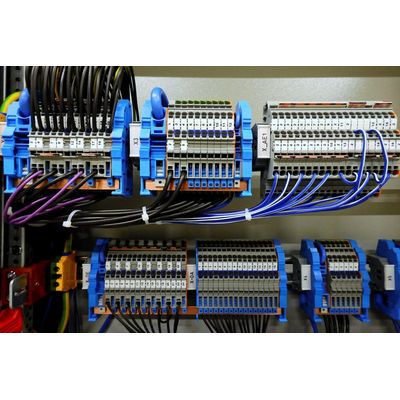
VEG/EE Gauge Control System
The gauge thickness variation of a rolled product is often considered one of the most important measures of the quality of the product. It is a measure of how closely the exit gauge tracks the desired nominal gauge as the sheet passes through the rolling mill. In practice, the largest contributors to excessive power in the gauge thickness variation are periodic disturbances occurring at frequencies higher than a typical feedback gauge control system is capable of tracking. Existing solutions to this problem come in two flavors. The first is to install an entry gauge and implement a feed forward gauge control system. However, this requires a large investment of several hundred thousand dollars in equipment and maintenance for an entry gauge.
More importantly, such a system is only capable of eliminating disturbances present on the incoming sheet; it can have no effect towards reducing periodic disturbances imprinted on the sheet by the rolling stand itself, such as those due to roll eccentricities. Hence eccentricity compensation systems, the second flavor of gauge thickness variation solutions, have been developed to eliminate in-stand disturbances, and indeed they have proven to be quite effective. Still though, today`s solutions require position encoders mounted on each roll within the stack in order to lock the phase between the disturbances and the corrective action, imposing additional hardware and maintenance requirements. Furthermore, because of the encoders these systems are limited to disturbances caused by the rolls themselves, and cannot effectively reduce disturbances due to other in-stand mechanical components such as the unwind and rewind handling equipment.
The VEG/EE system is designed to succeed exactly where previous systems are lacking. It does not require an entry gauge nor roll rotation encoders, and it is not limited only to those disturbances present on the incoming sheet nor to disturbances tied to the discrete rotation frequencies of the rolls in the stack. Instead, VEG/EE replaces the expensive and maintenance-hungry entry gauges and roll encoders with the latest in digital signal processing software capable of identifying, tracking, and eliminating cyclical disturbances present in the material exit gauge given a bare minimum of inputs.
The Virtual Entry Gauge/Encoderless Ecomp System (VEG/EE) is a complete, self-contained, process control system designed to significantly and efficiently remove all cyclic components in the gauge of a rolled material, thus substantially reducing the gauge thickness variation of the product. Its advantages include:
- Feed forward gauge control performance without the instrumentation
This system can identify and remove cyclic gauge disturbances found in the incoming material without the requirement of an entry gauge. - Encoderless roll eccentricity compensation
This system can compensate for cyclical gauge disturbances caused by roll eccentricities without the necessity for position encoders. - Packaged on PC platform
The system is packaged on a standard IBM PC running Microsoft Windows with IntervalZero RTX real time extensions. - Minimal I/O requirements
A bare minimum of mill-standard analog input signals are required and data acquisition is performed with a single internal PCI card. - User interface
All user interface is performed through a desktop application that can be installed on any Windows terminal. - Easy deployment
Because of its self-contained nature the system can be treated as a modular add-on to any existing mill control system.
Conventional gauge control systems based on exit gauge data have limited performance due to delayed feedback response. Major improvements come only with feed forward control, which in turn requires costly instrumentation. The VEG portion of the system, however, is capable of finding and correcting periodic disturbances present in the material incoming to the mill. Typically, such disturbances are due to fluctuations in the casting process or the effects of previous rolling passes and are too fast to be corrected by normal exit gauge feedback control. Hence digital signal processing algorithms are used to analyze harmonics in the exit gauge data and to compute the appropriate feedback control response, in effect providing the functionality of a virtual entry gauge. All entry disturbance frequencies within the dynamic frequency response of the mill control system can be identified and corrected.