


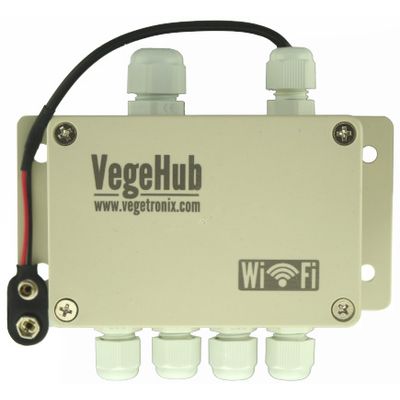
VegeHub - WiFi Control Hub
The VegeHub WiFi Control Hub allows you to control a powerful 16A 250V relay with local sensor inputs, or from a settable web address. It can control water pumps, sprinkler systems, alarms, lights, heaters, fans and valves. The VegeHub makes it easy to connect sensors to the Internet. View your sensor data from any web browser on your phone or your computer. Get text messages and emails from sensor triggers. It allows you to post data to common sensor data web sites, such as VegeCloud.com and ThingSpeak.
The applications for the VegeHub WiFi control hub are limitless.
Control anything from anywhere with input from local or remote sensors. It can control water pumps, sprinkler systems, alarms, lights, heaters, fans and valves.
The VegeHub WiFi control hub has all of the functionality of our standard 4 input sensor WiFI hub with the addition of a high capacity 16A 250V relay, which can turn on or off nearly any electrical device.
The relay can be controlled by settings from the local sensor inputs, or from an external web link, which you specify.
View your sensor data from any web browser on your phone or computer. Get text messages and emails from sensor triggers.
Within minutes you will be able to setup the VegHub and send data to common 3rd party web sites such as: VegeCloud, ThingSpeak, and Adafruit.
Get creative with how you use the WiFi control hub. For example, you can monitor and control chicken water tanks with AquaPlumb Sensors, and get an alert when the water is getting low. You can remotely control the soil moisture and temperature of your garden or greenhouse using VH400 soil moisture sensors, and THERM200 soil temperature sensors.
You`ll probably come up with applications we haven`t even though about. Drop us a email if you do, and we`ll post them on our site.
Built-in Security For Your Sensors
The VegeHub uses TLS 1.2 SSL for secure Internet connections, allowing it to do secure HTTPS posts to servers. If you don`t care about security, you can still post using regular HTTP.
The VegeHub comes with the most commonly used website certificates, or using our certificate tool, you can install your own.
Designed for Long Battery Life
One of our primary design goals for the VegeHub was long battery life. We wanted you to be able to place this anywhere without worrying about power connections. Under normal use scenarios batteries will last over a year.
We designed the hub with a power efficient latching relay. Power is only consumed for 40 milliseconds when the latching relay changes state. The rest of the time it consumes zero power, even when the relay is engaged.
The hubs come with a battery cable clip, suitable for standard 9V batteries. If you are using power from an adapter, you can replace the clip with your own wires.
For extended durations we recommend using a 9V AA battery pack with 6 AA batteries. We sell 9V AA battery holders. Use lithium batteries if the location will get cold.
You can configure the VegHub to send it`s battery voltage when it updates to the server, so that you can monitor its level.
Battery life depends on your sample frequency, and update rate. Most agricultural sensors change rather slowly, and so a sample rate of once per hour is often sufficient and will extend your battery life.
Make sure you don`t put batteries inside the box, because it is air tight, the batteries will off gas acid in the heat corroding the components.
Fast and Easy Setup
You can configure the VegeHub and add it to your local WiFi network by using a browser on your phone or PC.
Once you have connected it to your network you can plug in a USB thumb drive, and it will write its IP address to a file. This IP address allows you to configure it through it`s web interface.
To configure it, press a button, and it will become a mini web server on your network, and serve up configuration pages. Examples of the configuration pages are provided below.
These pages allow you to select the cloud site to which you want the hub to report data. Each channel can be independently configured with multiple options. For example channels can be configured to sample data periodically or, can be trigger on an event. The sensor warm up time is configurable, as well as how often the hub reports to the server. If your sensor is just a push button switch you can configure the channel to have pull up or pull down resistors. See the Quick Start Guide for step by step instructions.
Connect to Common 3rd Party Sites
The VegeHub will connect with websites such as VegeCloud, ThingSpeak, or io.Adafruit out of the box. These sites will graph your data, and allow you to create actions, such as send an email, when your sensor data has crossed a particular threshold.
We especially recommend: VegeCloud.com which will store your data, and allow you visualize it with graphs, and allow you to set triggers on your data so that you can get text alerts and email messages, when your sensors have passed a threshold value.
If you want to post to your own website, this is also possible, using our simple VegeHub API.
Rugged and Waterproof for Long Life in Harsh Conditions
You can put this box outside in the rain or snow. The rugged ABS plastic box has silicone rubber gaskets making it waterproof. All of the cable entry points use cable glands, so that no water or insects can get in.
The box has flanges and screw holes for easy mounting, so that you can put it anywhere.
Internally Stores Data When Internet is Down
If your Internet goes down - no problem. The Vegehub has an internal 64 sample storage for each sensor channel. The buffer is circular, so if the Internet goes down for tool long, such that the storage fills up before you can post the data to the server, the older samples will be overwritten.
Control the Relay with Internal or Remote Sensors on the Web
The relay can be activated by the conditions of local sensors connected to the hub, or can be activated by a value returned from a remote server.
In the case of using local sensors, you can flip the relay based on a sensor being greater than a value, less than a value, inside a range, or outside a range. For example, with a THERM200 soil temperature sensor on an input channel, you could turn on a fan with the relay, if the temperature gets too hot. Or, with a VH400 soil moisture sensor you could turn off the relay, when it rains, and the ground is wet.
The relay also has an advanced hysteresis setting, which reduces relay chatter from noisy sensors. Hysteresis increases longevity of pumps, valves or what ever you are controlling, because it prevents jitter. Most thermostats use this. Without it, your heater would turn on and off rapidly; as the temperature barely reached the target point it would turn off the heater, and then turn right back on seconds later as the room cooled. The hysteresis is single sided. For a better understanding of how hysteresis works in our system see this link: Single Sided Hysteresis.
What makes the relay hub so powerful, is that you can also activate the relay from any remote sensor on the web. In fact, it doesn`t even need to be a sensor, you could for example trigger the relay on abstract data such as a stock quote. When the hub reports data back to the server, it also will retrieve data from a URL that you specify. The data needs to be in JSON format, and can be a numerical or boolean value. You specify a conditional of greater than, less than, inside a range or outside a range, and if the condition is met, the relay will activate.
When configuring the relay hub, you enter in a URL and path to the JSON field which will trigger the relay. To help you figure out the path, we`ve created an on-line tool called PathGen which will parse a JSON response from any URL, and tell you the path for each value of the JSON.
You can also create lockout times using flexible time conditionals, such as allowing the sensor to only turn on at night time, if the sensor conditionals are met.
See the screen shots of the configuration pages to see how easy it is to setup relay conditions. Or, you can ignore sensor inputs, and trigger the relay on timed events. Merely create a sensor condition, that is always true, and the time condition that you specify will dictate the state of the relay.
Vegetronix Modular Building Blocks
Our product philosophy is simple. We provide low-cost modular building blocks to our customers, and then let them come up with their own applications.
Get creative with our very unique sensors, WiFi Hubs, Relay Boards and come up with your own creations.
- 16A 250V Relay.
- Relay is controlled by local or remote sensors
- Secure HTTPS connections using TLS1.2 Encryption.
- Will post to regular HTTP connections.
- Quickly display data on third party websites: VegeCloud.com, and ThingSpeak.
- Configurable URL allows it to post data to any website.
- Posts the device host name to networks scanners, for easy configuration.
- Internal storage of 64 samples for each channel.
- Long battery life.
- Simple setup.
- Water tight enclosure.
- Settable hysteresis reduces relay chatter.
- Box has flanges and screw holes for easy mounting.
- Easy to mount and compact.
- Control and monitoring of sprinkler systems.
- Control and monitoring of heaters.
- Control and monitoring of water tanks.
- Control and monitoring of lighting systems.
- Garden and farm automation.
- Alarm systems.