


- Home
- Companies
- Delphin Technology AG
- Products
- Delphin - Model Expert Vibro - ...
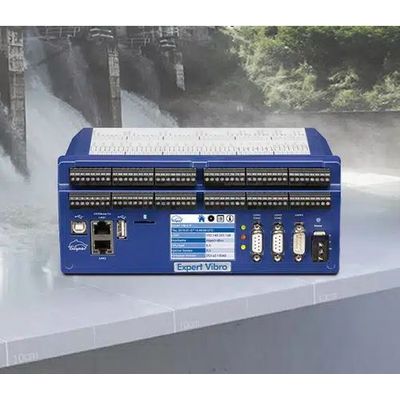
Delphin - Model Expert Vibro -Vibration Measuring Device for Vibration Data Acquisition and Vibration Analysis
With Expert Vibro, we have succeeded in combining complex functions and the requirements for high flexibility in a user-friendly vibration measurement device. The vibration measurement device opens up new fields of application where the use of vibration measurement technology was previously not economically efficient.
Vibrations deliver information on the condition of bearings, shafts and machinery and generally have a major affect on levels of quality in production processes. They should therefore be continuously acquired, intelligently evaluated and condensed into meaningful data for monitoring. In critical situations, machinery needs to be shut down within milliseconds.
Expert Vibro combines the requirements and functioning of modern vibration measurement systems into a highly compact device. Other systems usually require multiple equipment. Vibration measurement is made easy with Expert Vibro. System installation and familiarization are short so that users can quickly start processing their data.
With its Expert Vibro device, Delphin have successfully combined the processing of complex functions with high levels of flexibility in a user-friendly system. Vibration measurement systems can now be used where they had previously been economically infeasible. The device is equipped with a high powered, dual core FPGA processor based on ARM technology giving users ample reserves of processing power.
Users are able to switch between voltage measurement, IEPE or shaft vibration sensors. Integrated comparators and digital inputs allow flexible triggering. Measurement data is monitored "on the fly" with digital outputs being switched within msecs in the event of limit value violations .
Expert Vibro provides users with analysis and monitoring functions, intelligent signal processing, an independent data storage capability and versatile fieldbus connections – all in a single device. Right from the outset, users save costs and avoid troublesome interface problems.
- 4, 8, 12, 16 synchronous analog inputs, 50 kHz sampling rate per channel, IEPE, mV, mA sensors selectable via software
- Integrated comparators for KeyPhasor® sensors
- 32 GB data logger memory in the vibration meter
- 4 digital inputs for frequency measurement up to 1 MHz
- 4 analog outputs for monitoring
- 8 digital outputs
- Display for reading data on-site
Your benefits with Expert Vibro vibration measurement technology
Of special benefit is the modular system for signal processing with a range of preprocessing functions. Filters, such as high, low, or bandpass with rectifiers, integrators, differentiators or decimators can be selected to make up a preprocessing sequence. Multiple preprocessing sequences are able to run in parallel in order to evaluate an input signal. This gives users an especially high level of flexibility.
Non-periodic signals, such as in fault diagnostics, can be analysed precisely using Expert Vibro. In continuous sampling mode, even the smallest of irregularities are recorded. Expert Vibro measures, monitors and records fully independently. Expert Vibro is equipped with its own internal data storage capability making it especially reliable and secure.
- Shaft vibration monitoring and analysis
- Machine and housing vibrations
- Combustion chamber vibration monitoring
- Gear box analysis
- Roller bearing monitoring and bearing damage diagnostics
- Mobile vibration measurement
- Airgap monitoring
The Expert Vibro is equipped with 4, 8, 12 or 16 synchronous analog inputs with sampling rates of up to 50kHz per channel. It uses a 24-Bit A/D converter to guarantee a high-precision measurement. Channels are all galvanically isolated from each other. This prevents the occurrence of any transverse interference between channels. Integrated comparators and digital inputs allow flexible triggering. Measurement data is monitored "on the fly" with up to 8 digital outputs that can be switched within msecs in the event of limit value violations.
Software channels are available to systematically group limit value violations into batch alarms. Instead of using digital outputs, alarms can also be processed via fieldbus interfaces. Characteristic values or raw time signals from analog inputs can be output to two analog outputs.
Here you will find an overview of the standard and optional hardware interfaces and protocols Learn more about the variety of interfaces of our measurement technology software.
Expert Vibro can be connected to a network via a LAN interface or to a PC via a USB connection. For field bus connections, the device has two PROFIBUS DP Slave interfaces, a Modbus TCP and a Modbus RTU, and a user-configurable CAN interface.
The interfaces can alternatively be used to connect any other measurement equipment and sensors via RS232/485 ports. Expert Vibro is integrated into PROFIBUS via a GSD file. An option is available to switch operating mode to redundant (according to PNO 2.212 V1.2) PROFIBUS. The LAN and RS485 interface can also exchange data via the Modbus TCP/RTU protocol.
Expert Vibro supports this operation as a Modbus master or slave. The LAN interface transmits all data from measurements and software channels online and at high speed across the intranet or internet. Any networked PC can access the device via this interface. To measure vibrations from multiple channels, multiple Expert Vibro devices can be synchronized with each other.
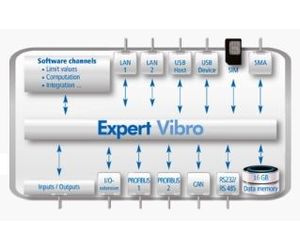
Expert Vibro
Inputs / Outputs
Analog inputs: 8 or 16
- Sampling rate, adjustable per channel: 20 Hz .. 50 kHz
- Usable signal range: DC .. 20 kHz
- Voltage / current ranges: ± 25 V / 0 .. 20 mA / 4 .. 20 mA / free
- Signal conditioning, software switchable: None, AC coupling, IEPE
- Resolution / input impedance: 24 bit / 4 MΩ
- Dielectric withstand voltage: ± 100 VDC
- Galvanic isolation / channel to channel / channel to system / PE: ± 400 VDC
- Measurement accuracy: 0.5 mV + 0.008 % from measurement
Digital inputs: 4
- Input signal: low: 0 .. 2 V / high: 5 .. 100 VDC@3.5 mA
- Galvanic isolation / channel to channel / channel to system / PE: ± 400 VDC
- Max. input frequency / min. pulse width: 1 MHz / 500 ns
Analog outputs: 4
- Resolution: 16 bit
- Output ranges: 0 .. 10 V / ± 10 V / 0 .. 20 mA / 4 .. 20 mA / ± 20 mA
- Galvanic isolation / channel to channel / channel to system / PE: ± 400 VDC
- Min. load / max. burden: 650 Ω
Digital outputs: 8
- Switching voltage / current / PWM: 50 V / 2.5 A / galvanically isolated / 5 Hz .. 10 kHz, to 1:1000
Data storage
- Internal / external
- 2 .. 14 GB ( approximately 30 million measurements per GB) / USB, NFS, CIFS, (S)FTP
Signal comditioning functions
- High-pass / low-pass/ bandpass filter:
- Cut-off frequency / filter ordering / filter characteristic: 5 .. 20 kHz / 4, 6, 8, 10 / incl. Butterworth
- Integrator / Differentiation:
- Single or double integrator / differentiator
FFT:
- Line number / window function / averaging: 400 .. 12.800 lines / von-Hann, Hamming, Flat-Top / 2 .. 32 times
- FFT types: Narrow band / wide band, envelope / demodulation, amplitude / phase spectra
- Characteristic values from time signal
- Maximum / minimum value, peak-to-peak value, arithm. average, TRMS, max. vect. sum, local min. / max. values
- Characteristic values from frequency spectrum
- Amplitude, frequency and phase of main oscillation and any harmonics, sum value, quadratic mean (in any frequency band), sum or remainder value
- Characteristic values on digital input:
- Frequency: 1 Hz .. 1 MHz
- Counter: 32 Bit, UP-Down counter, quadrantur decoder
Interfaces
- Physical equipment COM 1 / COM 2: RS485, 9-pole sub-D plug, DIN EN ISO 19245-1
- Physical equipment COM 3: RS232, 9-pole sub-D plugs
- LAN: 1 x 1000Base-TX
- WLAN / WWAN (optional): 802.11b/g/n / GPRS, UMTS, LTE max. 100 Mbit/s
- USB: Device 2.0 / host 2.0 / low / high / full
- PROFIBUS: 2 x PROFIBUS DPV1 / Slave max. 12 Mbit, also redundant to PNO 2.212 V1.2
- CAN / RS 232/485: 2 x CAN 2.0 / Modbus RTU, SCPI, ASCII
- TCP/IP: Modbus TCP, OPC UA
General technical information
- Dimensions / weight: 210 mm x 80 mm x 125 mm / 750 g
- Fixing: Rail mounting DIN EN 60715 or screw fixing
- Signal connections: Plug-in screw terminals, 96 terminals in 2 rows, max. 1,5 mm²
- Temperature range: -20 .. 50° C
- Power supply: 12 .. 24 VDC / ± 10%
- Power input: max. 10 W