


- Home
- Companies
- Crystal Instruments
- Products
- Spider - Model 81/81B - Vibration Test ...
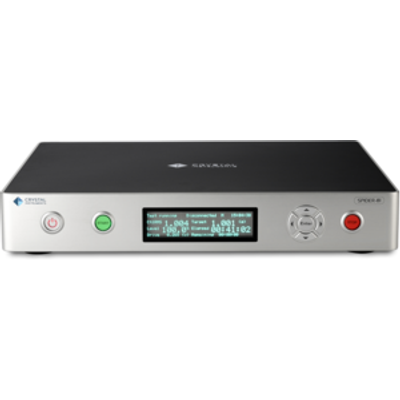
Spider - Model 81/81B -Vibration Test Controller
Unlike traditional vibration test controllers that rely heavily on an external computer for real-time operation, the Spider-81 is the first vibration controller that directly integrates time-synchronized Ethernet connectivity with embedded DSP technology. This strategy greatly increases the control performance, system reliability and failure protection of the vibration test controller. It also allows a large number of channels to be configured without sacrificing system performance.
Latest Hardware Design
Spider-81 vibration test controllers have voltage, charge, TEDS, and IEPE inputs which are ideal for shock, vibration and acoustic measurement or general purpose voltage measurement. The internal flash memory stores test configuration data for controlling up to 64 channels simultaneously in addition to storing real-time analysis data. Multiple output channels provide various signal output waveforms that are synchronized with the input sampling rate. A bright LCD screen displays testing status information. Ten monitoring connections on each unit are used to read signals of analog inputs and outputs. Built-in isolated digital I/O and RS-485 serial ports enable interfacing with other hardware.
Simple Network Connection
Ethernet connectivity allows the Spider-81 vibration test controller to be physically located far from the host computer. This distributed structure greatly reduces the noise and electrical interference in the system. One computer monitors and controls multiple controllers over the network. Since all the control processing and data recording are executed locally inside the controller, the network connection will not affect the control reliability.
Time Synchronization Between Multiple Test Controllers
The Spider-81 vibration test controller is built on IEEE 1588 time synchronization technology. Spider-81 vibration test controllers on the same network are synchronized within nanoseconds. With such unique technology and high-speed Ethernet data transfer, the distributed components on the network truly act as one integrated system.
Vibration Testing Software Features
- Random Vibration Control
- Sine-On-Random (SoR)
- Random-On-Random (RoR)
- Swept Sine Vibration Control
- Resonance Search Track & Dwell (RSTD)
- Multi-Sine
- Sine Oscillator
- Classical Shock Control
- Transient Time History (TTH)
- Shock Response Spectrum (SRS) Synthesis
- Transient Random Control
- Earthquake Testing Control
- Time Waveform Replication
- More Vibration Control Software Options
- Analog Inputs: 8 BNC connectors per Spider-81 vibration test controller. Spider-81 and Spider-80X front-ends can be networked to form a 512 channel count system. Charge, voltage or IEPE, single-ended or differential, AC or DC coupling, 160 dBFS dynamic range, 24-bit A/D converters, range ±20 volts, up to 102.4 kHz fs per channel, 8 BNC connectors per Spider-81 front-end.
- Analog Outputs: 2 BNC connectors per unit, 100 dB dynamic range, 24-bit D/A converters. ±10 volts
- Channel Phase Match: better than ±1.0 degree, up to 20 kHz
- Peripherals: 8 isolated DIO; 10 monitoring channels, LCD display with navigation buttons, RS-485, ground connection, abort contact switch, start and abort buttons
- Dimensions: 440 x 66 x 330 mm (WxHxD)
- Weight: 4.2 kg
- Power: Up to 18 watts during operation.
- Computer Connections: 100Base-T, RJ45 female connector supports connection to computer or network switch
- Internal Memory: Flash memory for data storage is 4 GB per unit
- Operation Modes: Connected to computer or stand alone Black Box mode.