


- Home
- Companies
- Vibrotechnik LLC
- Products
- Vibrotechnik - Model S 12/38 - ...
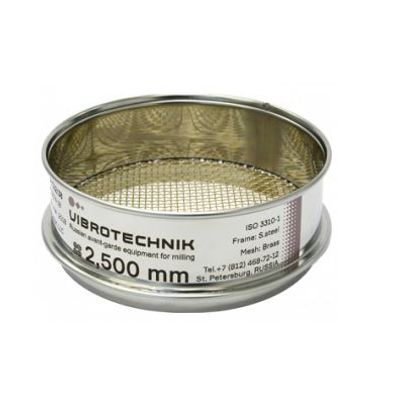
Vibrotechnik - Model S 12/38 -Laboratory Sieve
Laboratory sieve S 12/38 consists of a frame, a sieving surface, a connecting element and a shock-absorbing sealing ring. In the place of attachment of the sieving surface and on the upper end of the frame, radial shoulders are made, and in the middle part there is an embossing, which ensures the rigidity of the sieve. Sieve S 12/38 diameter 120 mm, height 38 mm.
- Diamonds, ferroalloys, ore, metal powders, coal, glass, ceramics, polymers, peat, cereals, coffee.
- Mining
- Metallurgical
- Food
- Construction
- Chemical
- Pharmaceutical
SIEVES COMPATIBILITY
Laboratory sieves S 12/28 are compatible with Ø 120 mm sieves of other brands.
NO CROSS-CONTAMINATION OF SAMPLES
The sieve frame is made of stainless steel (AISI 304).
SIEVE SHAKERS COMPATIBILITY
S 12/38 sieves can be used in sieve shakers S 12 based on VD 30, VD 30T, VPS.
MESH MATERIAL
- stainless steel
- brass
- bronze
- polyamide
SIEVES WITH PERFORATED PLATE
In S 12/38 sieves, a perforated stainless steel plate with round or square holes is used. Laboratory sieves with standard openings are made of perforated sheet, and non-standard sieves are laser cut. Minimum size of the openings is 0.8 mm.
DAMPING RINGS AND EMBOSSING
The shock-absorbing sealing ring eliminates the collision of the sieves and ensures their tight connection to each other, and also facilitates the disassembly of the sieve column. Radial shoulders and embossing provide high rigidity of the sieve.
CALIBRATION CERTIFICATE
Production quality is confirmed by a calibration certificate.
LASER ENGRAVING
Laser engraving labeling contains the following information:
- Sieve type
- Opening size
- Serial number
- Date of production
- Specifications
- Frame material
- Sieving surface material
- Contact information
DESCRIPTION OF THE DEVICE
The sieving element is tightly attached to the frame. The exclusion of cavities and gaps in which particles of material can accumulate reduces the risk of cross-contamination of samples, improving the quality of the sieve analysis.
Labeling is performed by laser engraving.
Types of perforated plates:
- Plates made of standard perforated sheets;
- Plates with zone perforation;
- Laser cut plates.
The sieve analysis is performed using one or more sieves, a tray and a cover. The number of sieves, as well as the mesh size or the size and shape of the perforated plate apertures are determined by the conditions of the analysis.
The sieve column can be equipped with intermediate rings to increase the height of the sieve, which allows loading larger samples onto the sieve, as well as intermediate trays for installing several sets of sieves in one column.
The material to be sieved is loaded into the upper sieve. The sieve column complete with tray and cover must be shaken manually or using a VD 30, VD 30T, VPS vibration drive. Using the vibration drive allows to increase productivity of sieving due to high-frequency reciprocating screw oscillations of the platform on which the column of sieves is fixed.
Particles of material which are smaller than the size of the sells / apertures in the sieving surface of the upper sieve fall through on the next sieve, where the cycle repeats. As a result, the sample is distributed between the sieves and the tray in accordance with the fractional content. At the end of the sieving process, the contents of each sieve are weighed and the particle size distribution of the sample is determined.