- Home
- Companies
- Vitrovex Deep Sea Housing by Nautilus ...
- Products
- Vitrovex - Model NMS-FS - Floatation ...
Vitrovex - Model NMS-FS -Floatation Spheres
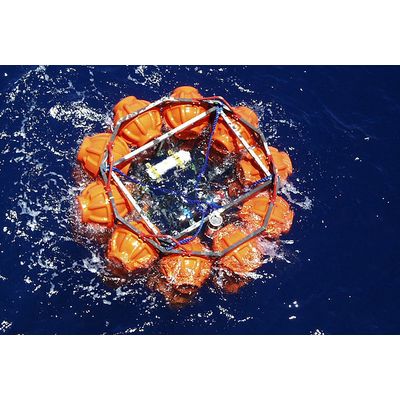
VITROVEX floatation spheres are composed of two mated hemispheres that are evacuated and locked into position by a sealant and a protective tape. Once the spheres are sealed, the two hemispheres are kept together by the atmospheric pressure on land and the pressure of the water column when deployed. VITROVEX floatation spheres are sealed during fabrication in a vacuum chamber and supposed to remain sealed during their whole lifetime. Precision moulding of the highest quality glass, skilled craftsmanship and strict quality control ensures that VITROVEX spheres show very little deviation in shape even under high pressure. VITROVEX spheres are to a very large degree free of imperfections, and parting plane sealing faces are honed to a precise flatness and finish. However, Nautilus Marine Service recommends checking floatation spheres before and after deployment for any signs of chipping or damages that may jeopardize the integrity of the pressure housing.
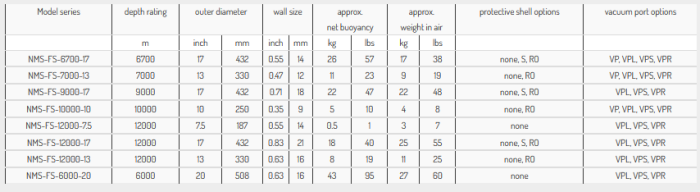
The table below shows the characteristics for the most common floatation spheres and their configuration options. This list shall be regarded as selection guide rather than a definitive list.
If your preferred glass enclosure is not listed, please get in touch with Nautilus Marine Service or your nearest representative to discuss more options.
The calculated buoyancy value of 260N for a 17” with 14mm wall size (and all other buoyancy information respectively) is based on the dimensions and the density of VITROVEX glass and the density of sea water. Since the density of sea water varies (1.02 to 1.03) and production tolerances for a particular enclosure may apply, this value is a good approximate; in particular, if VITROVEX spheres are used together with its protective shells. Since protective shell sets are slightly positive, one can safely assume 260N for doing any buoyancy calculations. However, without protective shells one may reduce the given buoyancy value by 5N.
Nevertheless, Nautilus Marine Service always advise to consider a safety margin in your buoyancy calculations to reflect other influences such as current or temperature changes or miscalculations on the actual weight of the equipment.