


- Home
- Companies
- National Electric Coil (NEC)
- Products
- VPI Coils & Bars
VPI Coils & Bars
National Electric Coil’s premier stator coil and bar design utilizes a proven, Class F, epoxy mica insulation system called NECCOBond-E. The NECCOBond line has been offered by NEC for many years, initially as a Class F polyester mica insulation system. However, in the last twenty years, NEC upgraded its design to a Class F epoxy system, hence the “E” in NECCOBond-E.
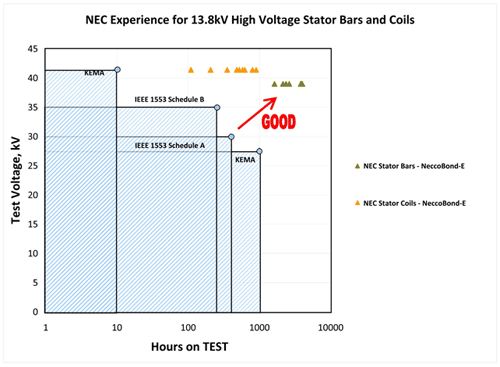
Since this time, NEC has developed an unparalleled record for reliability in the new stator windings it has manufactured and installed, and this record surpasses that of many major OEM’s. Our conservative design approach, high-quality manufactured materials, methods and processes, combined with our extensive R&D development program and routine and type testing, all contribute to making long-term reliability for your generator possible.
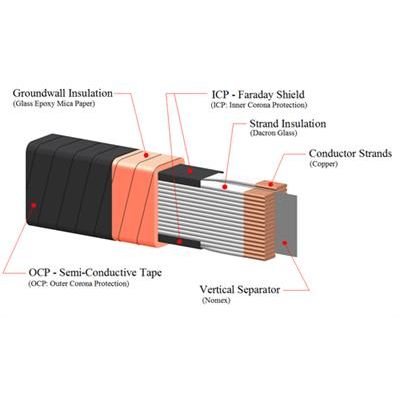
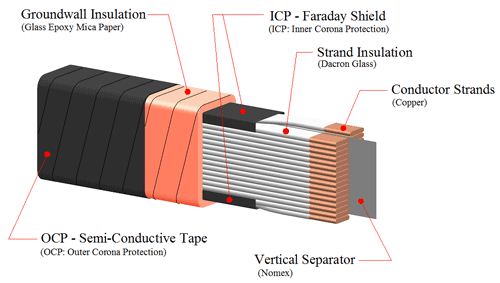
A key difference, the NEC system features individually Vacuum Pressure Impregnated stator bars and coils. Each VPI’d coil consists of a number of key components shown in the first tabbed section below. NEC’s individually VPI’d coils and bars with the NECCOBond-E proven insulation system meets every National and International Standard, and is the right solution for your next rewind.
NEC’s individually VPI’d coils and bars with the NECCOBond-E proven insulation system meet every national and international standard. They are the right solution for your next rewind. Shown in the illustration at the right is a single turn bar for a large turbogenerator. Although many variations are possible to suit specific design parameters, one of the common elements for making a coil or bar are individually copper strands insulated with two layers of fused Dacron Glass. Turn insulation, used in multi-turn designs, and ground wall insulation are made of multiple layers of epoxy mica paper insulation. Our insulation tape also has accelerating agents to draw in the Class F epoxy resin during the VPI process.
We realize that there are other coils and insulation systems sold on the market today, different from ours. Each of these systems has advantages and disadvantages. However, we believe that NEC’s VPI coils and bars provide the best long term reliability of any other offering on the market today.
Ability to Supply Rotor Windings of Any Type
- New or Refurbished Winding
- Copper or Aluminum
- Direct or Indirect Cooling
- Square or Edge-Bent End Winding Corners
At our Columbus turbogenerator rotor facility, we have made a significant investment in design, equipment and process development for our rotor winding manufacturing line. This includes the achievement of ISO 9001:2008 certification for our quality management systems. NEC manufactures windings with either style of end winding corners — square or edge-bent as shown above. Typically, old windings are replaced with new ones of similar design. Throughout manufacturing, our focus is quality. All brazed joints, whether in the corners or in the arch, are UT tested to prove their durability.
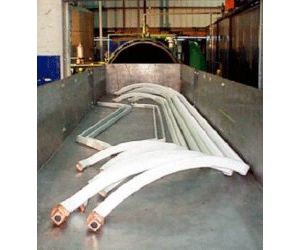
VPI requires a significant capital investment in specialized equipment, but the quality and reliability of the resulting product make it a superior choice for winding manufacture over other methods such as Global Vacuum Pressure Impregnation (GVPI) or some of the Resin Rich processes. The VPI process involves four distinct steps. First the insulated conductor coils and bars are placed into the VPI chamber. Each coil or bar is heated to drive off any moisture or volatiles. Then a vacuum is used to pull out any trapped air that might cause pockets or voids. Next Class F epoxy resin is injected to saturate and permeate the ground insulation, filling all voids and gaps. Finally the tank is pressured with nitrogen gas to force the resin into every part of the coil insulation system. After the VPI process is complete, each bar or coil is placed in custom machined and heated steel dies to cure the epoxy mica insulation system to the size and shape needed to properly install in the generator.
When specifications outline industry-accepted performance parameters, a well-made winding made up of individually VPI`d coils or bars will always meet these criteria, while windings made by other methods may not.
In-Process Checks a Must!
At every step of our manufacturing process, quality checks are made to assure the best workmanship. NEC`s Brownsville factory utilizes ISO9001-certified quality management systems.
Every Coil or Bar Tested!
Every coil and bar undergoes both in-process testing and final testing before it leaves the factory. These "tests" include both specified electrical tests as well as various dimensional checks.
Uniform Shape Assured!
A coil or bar must be uniformly shaped in order to wind the machine properly and to avoid problems that may initiate corona during operation. Dummy cores are used to check critical clearances in the end turns and overall fit in the stator core. Multiple checks are made at different stages of manufacture.