


- Home
- Companies
- Vsparticle B.V.
- Products
- Vsparticle - Model VSP-P1 - NanoPrinter
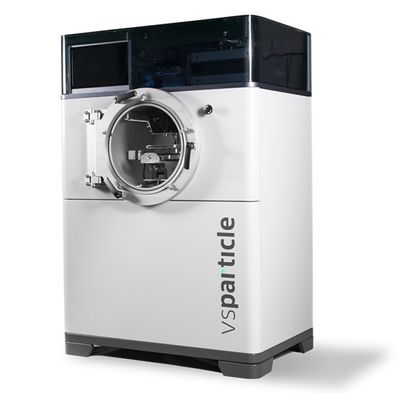
Vsparticle - Model VSP-P1 -NanoPrinter
VSPARTICLE introduces the The VSP-P1 NanoPrinter, the ultimate prototyping and R&D platform for material development and small scale production testing. This new way of additive manufacturing can greatly simplify the production of nanoporous thin films and layers with a high surface-to-volume ratio. The applications of such films are numerous and include for example electrocatalysis, chemical, optical or biological sensing as well as the fabrication of batteries and microelectronics.
The VSP-P1 NanoPrinter enables you to locally print inorganic nanostructured materials with unique properties. The building blocks for the printed layer are gas-phase produced, sub-20 nm nanoparticles, free of surfactants or any other organic impurities. With the VSP-P1 NanoPrinter, semi-automated printing of nano porous layers of different composition and/or layer thicknesses is possible. Check out our
Applications for inspiring examples!
- Aerodynamic size 0-300nm particle size: 0-20nm
- Any (semi) conductive material
- Stable & reproducible
- Quick & easy-to-use
- Based on Spark Ablation Technology
- Clean process: no surfactants or precursors
Controlling layer width & thickness
Different layer thicknesses from sparse agglomerates to continuous layers up to a few microns thick are possible using the VSP-P1. The parameters that impact the layer thickness are:
- Nozzle distance to substrate
- Power of ablation
- Printing speed
Patterning
You can determine the desired printing pattern by running a script through the user interface. Both complex patterns and in-series production of more than one samples are possible using different or modified scripts.
Automated experimentation & data logging
The VSP-P1 NanoPrinter can be controlled directly through the on-device touchscreen, as well as remotely through the hybrid control interface accessible from any device with an internet connection.
All experimental data is logged and can be visualized within the interface.
Development of efficient catalyst coated membranes (CCMs) is crucial for the transition towards a hydrogen-based, low carbon economy. Conventional CCM production processes require multiple steps and high loadings of scarce metals. To tackle this challenge, VSPARTICLE introduces membranes. By combining spark ablation, a vapor-based nanoparticle synthesis method, with additive manufacturing, production process of CCMs is simplified and catalyst loading is reduced without compromising performance or durability.