

- Home
- Companies
- Wahaso - Water Harvesting Solutions, ...
- Products
- Wahaso - Commercial Rainwater ...
Wahaso - Commercial Rainwater Harvesting Systems
Unlike the simple systems installed by other rainwater harvesting companies for homeowners, our rooftop rainwater harvesting systems are designed with the commercial-grade components and sophisticated controls required in commercial buildings for reliability, automated functions and connectivity to BAS systems. The Wahaso commercial rainwater harvesting systems produce treated water that is safe and suitable for non-potable applications such as toilet flushing, irrigation and cooling tower make-up.
Wahaso commercial rainwater collection system is designed to meet rigorous commercial building and regulatory requirements. The first step in any Commercial Rainwater Harvesting Systems is pre-filtration upstream of the cistern. This helps to keep the cistern clean and reduce the load on downstream processing equipment. Wahaso rainwater harvesting for commercial buildings uses a variety of pre-filters including hydraulic jump cascade filters, NSBB units, vortex filters, downspout filters and more.
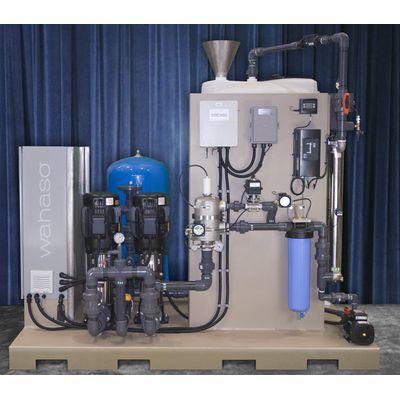
After pre-filtration, the harvested water is stored in a cistern rainwater harvesting storage. (See Storage for more information.) The Wahaso system includes transfer pumps that convey the water from the cistern rainwater harvesting storage to a skidded processing system where it is filtered and sanitized for reuse. Wahaso uses Ultraviolet (UV) sanitation in our rooftop rainwater harvesting systems, which kills pathogens and bacteria that can present a health risk. Chlorine can also be used for applications such as toilet flushing, where residual sanitation is required.
- The Right Size for the Job. Wahaso’s proprietary pre-design analysis helps to determine the proper size for any rainwater system. A system that is too large is not cost-effective, but under sizing a system can lead to lost potential.
- Low Maintenance. The Wahaso system has been designed for minimal maintenance with few consumables.
- Integrated System Design. Wahaso’s greywater processing skids are pre-assembled and integrated into comprehensive system designs that include all pumps, storage, filtration, sanitation and controls.
- Robust Controls. Wahaso’s proprietary control system is custom programmed to monitor and track all system activity.
Wahaso offers both standardized and custom rainwater harvesting systems. Our standard systems are designed for both small and medium-sized projects and incorporate filtration, sanitation and tank sizing. If our standard systems do not fit the project, Wahaso will work with architects and engineers to design a custom system. For more information on our standard rainwater harvesting systems, download the information sheets.
Because storage capacity, type and location are primary drivers of system design and cost, this is one of the first analyses done on any project. Wahaso works with clients early in the process to think through the supply and demand side of the system and determine the most efficient size, type and location of the storage system.
On the supply side, we calculate total rainwater available to the system by measuring collection surfaces on rooftops and parking areas and applying average monthly rainfall for the building location. On the demand side, we help determine anticipated monthly demand for toilet flushing, irrigation, cooling tower make-up and other uses. Storage options include above-ground tanks that can be located inside or outside the building and subterranean tanks that can have unlimited storage capacity. For a more thorough review of the different storage options for harvested water, see our Harvested Water Storage page.
Most systems have a connection to a municipal water source to provide a constant supply of water during drought periods – especially when the system is being used to flush toilets. A level and control system automatically maintains a minimum level for this purpose.
A repressurization system is required to move the rainwater to toilets throughout the building. Typically, the system includes duplex pumps in tandem with each pump alternating in operation. If a high demand situation occurs, both pumps can be made available. And if one pump should fail, the system will continue to provide harvested water. It is important to properly size the pumps so that adequate pressure and volume is available at the farthest – and highest altitude – end point in the system.
Our proprietary software is customized for each application and provides the capability of interfacing with building automatic systems and other alarm and condition monitoring.
In addition to monitoring the system mechanicals, the control system can track the amount of water in each tank and track and display the monthly amount of water harvested. An interface allows remote monitoring via a web page for maintenance or educational purposes. Wahaso Commercial Rainwater Collection System unlike other Rainwater Harvesting Companies can use the remote access to help a building maintenance staff diagnose potential system problems.