


- Home
- Companies
- Waldner Holding Se & Co. Kg
- Products
- Waldner - Laboratory Fume Hoods
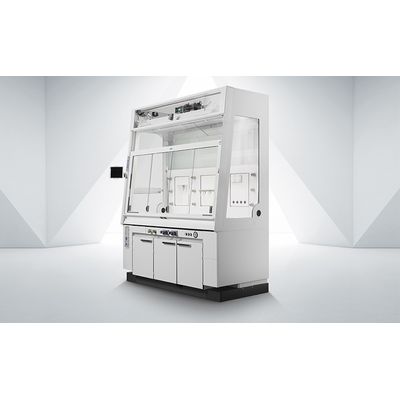
Waldner - Laboratory Fume Hoods
Greater transparency – better communication
The concept of transparent laboratory fume hoods creates new laboratory environments that revolutionise the feeling of space and collaboration. The Secuflow Vision stands out on account of its glazed rear and side walls and inclined front. Many more functional features offer considerable added value to users.
Transparent side and rear walls
Different glazed versions of the solid side panels of the fume hood and its rear wall have been developed. They ensure direct communication with the workstation opposite and create maximum transparency for an open and bright laboratory.
Transparency when required
The glazing panels above the service modules can optionally be switched from clear glass to opaque glass.
Supportive flow air is also blown out over the air foil cills, avoiding turbulence and flushing harmful gases safely away from the side walls and work surface. The Secuflow achieves outstanding retention values even in the event of densely packed equipment in the internal space or intensive movement in front of the fume hood. Its outstanding test results go beyond the requirements of DIN EN 14175 and ASHRAE 110. It also reliably protects the people working at the fume hood.
With continuous laboratory operation, a standard fume hood consumes around as much energy as a single-family home each year. This means that the ventilation of the laboratory is usually responsible for a considerable proportion of the laboratory operating costs. Not the case with Secuflow laboratory fume hoods! The Secuflow laboratory fume hood targets supportive flow air from the aerodynamically shaped air foil cills of the side wall and table edge into the internal workspace, preventing turbulence and ideally stabilising the inflow.
The air distribution in the fume hood, optimised in terms of flow technology, enables the extract air volume to be reduced by up to a third – coupled with totally safe operation. The air flow rate is thus reduced to 270 m³/h/m, resulting in significant energy savings.