


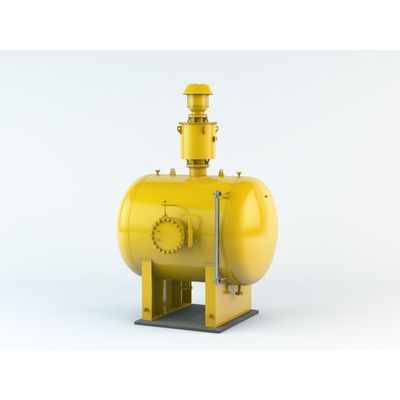
Mueller - Model VTS -Waste Tank Vent Mist Extractor
The Mueller Model VTS Waste Tank Vent Mist Extractor for pipeline suction scrubber sump vent applications removes entrained lubrication, condensation, water and other fluids from venting natural gas over a wide range of discharge exhaust flows. With no moving parts, the VTS is highly reliable, and its operating principle has been widely field proven. As natural gas and entrained fluids enter the VTS via the inlet nozzle, flow impinges on two distinct stages of separation, removing the entrained fluids, with only clean gas ultimately venting to the atmosphere.
When the suction scrubber sump vent valve is opened manually, the operator often opens it only slightly, allowing only a very low flow of gas and fluid to vent to the waste tank. During this type of operation, the 1st stage separating element acts as a coalescer, working on the principle of directional change. Gas and fluids flowing through the coalescer element change direction several times. Fluids are caught on the knitted wire of the mesh pad and flow down to the bottom of the element where they are held in place by surface tension. Eventually, the coalesced fluid becomes a large enough droplet to overcome the surface tension and up-flowing gas velocity and falls into the liquid holding sump.
When the suction scrubber sump vent valve is completely opened, manually or automatically, gas and fluid vent through an orifice at pipeline upstream pressure allowing high flowing vent conditions. During this type of operation, the first stage separating element acts as an agglomerator. As in low-pressure operations, the liquids are caught on the knitted wire mesh pad, but under higher force, they now flow to the top of the element due to the increased up-flowing gas velocity. The longer the vent valve is opened, the greater the vent flow and velocity, which carries the agglomerated fluid to the second stage centrifugal separator. That separator slings the liquid particles to an inner shell wall where, due to sheeting action, the fluid flows into side wall traps and is carried between the inner and outer shell where, due to gravity, it falls into the fluid holding sump.
- Field proven for years over a wide range of conditions
- Low-pressure drop
- No moving parts
- Engineered and constructed for low maintenance and durability