


Variolytics GmbH

Wastewater Emissions Monitoring and Control System (EmiCo.™)

SHARE

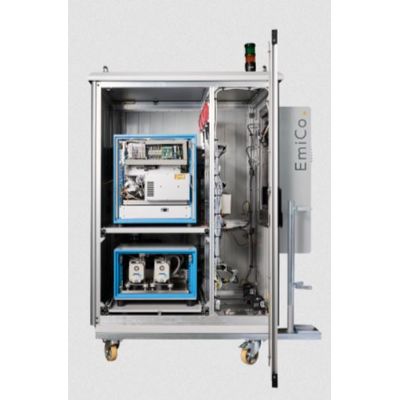
The Variolytics Emission Control System (EmiCo.™) is the first analysis system in the world that can directly measure greenhouse gases produced during wastewater treatment. It enables the wastewater industry to meet their emission reduction targets by mitigating nitrous oxide (N2O) production in the treatment process. EmiCo is a patented measurement technology coupled with process optimization software, delivering wastewater utilities a system solution to reach net-zero.

Most popular related searches

50%
reduction in total emissions (CO₂e)
12
spots simultaneously measured
20%
reduction in energy costs (KWh)

Gas & Liquid Measurements
Simultaneous measurement of nitrous oxide (N2O) and methane (CH4) in the gas and liquid phase
EmiCo is the first analyzer for wastewater treatment plants that can measure values simultaneously from the liquid and gas phases. Our measuring method enables the formation of greenhouse gases in the aeration tank to be precisely monitored. In order to control the process correctly, it is important for operators to determine the formation of nitrous oxide and methane in the liquid phase.  Alternatives can measure only from gas or only from liquid. EmiCo does both, and is therefore unique in the market.
 

Multiplexing

Measure up to eight aeration tanks simultaneously with one analyzer
We can already analyze up to 8 aeration tanks simultaneously in wastewater treatment. Simultaneous measurement works by switching valves on the analyzer. The measurements are carried out serially, with each measuring point being monitored by the analyzer for 2 minutes. The multiplexing method reduces the costs for expensive measurement technology and high maintenance costs, since only 1 analyzer is required for several measurement points.
 

Sensitive

Large measuring range, low detection limits from the ppb to the 100% range
The measurements from the EmiCo. system are carried out using a process mass spectrometer. Mass spectrometry is characterized by its high measurement sensitivity. As a result, measurements can be made from the low ppb to the 100% range without any problems For monitoring emissions, gas and liquid phase sensitivities of 0.5ppm for nitrous oxide (N2O), 0.9ppm of methane (CH4), and 0.4ppm of CO2 can be achieved. With EmiCo, operators of wastewater treatment plants have the possibility to monitor greenhouse gases in their aeration tanks very sensitively and in real time.
 

No Drift

Auto-calibration with reference gas prevents drift in the measurement result from occurring
The EmiCo system has a reference gas container next to the analyzer, which allows the system to calibrate itself automatically on a daily basis. The reference gas is a mixture of all measurement-relevant gases. This prevents a drift in the measurement result for measurements over a longer period of time. For customers, this results in savings of time and money for costly calibration of the measurement technology. The auto-calibration of the EmiCo system thus guarantees process reliability. Measured values of greenhouse gases are therefore always accurate.
  • Automated reporting on direct emissions for regulators
  • Reduced chemical demand
  • Increased visibility on the metabolism of the microbiology
  • Optimization mitigates N₂O emissions -> energy consumption is kept at a minimum
  • Robust, real-time measurements 24/7, with insights into the state of the microbiology
  • Auto-calibration with reference gas prevents drift in the measurement result

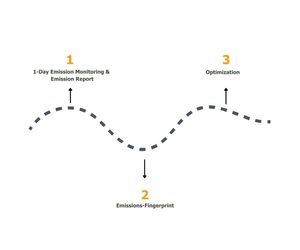
We initiate the optimization process through a questionnaire-based preliminary analysis. Following that, we identify preferred measuring points and calculate emission and uptake rates. By considering different scenarios, we determine the annual emissions. Our estimations cover the emission factor (EF), energy savings, CO₂e footprint, and the potential emission reduction. Additionally, we capture all emission-relevant parameters throughout the entire wastewater treatment plant and consider the impact of weather events and seasonal effects. As a result of these optimization steps, we can successfully achieve energy savings of up to 20%, emissions reduction of up to 50%, and significantly reduce the need for chemicals in the process.