


- Home
- Companies
- EVALED - Evaporator - Veolia Water ...
- Products
- Evaled - Model AC F Series - Wastewater ...
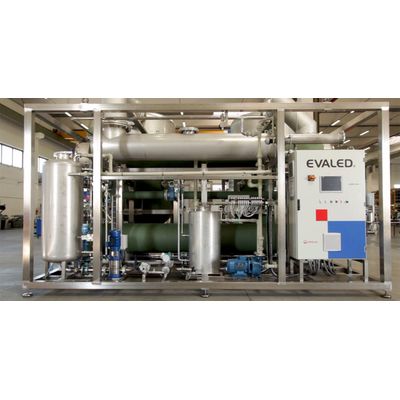
Evaled - Model AC F Series -Wastewater Treatment Evaporators
The PC F series evaporators represent the most versatile range in the entire EVALED catalogue. These units utilise heat pump technology to provide effective treatment of industrial wastewater at low temperatures. The evaporation of the waste takes place at a maximum temperature of 40° C due to the vacuum condition created inside the boiling chamber.
up to 95% reused water
5% concentrate for disposal
In this way, the 8 models of the PC F series make it possible to treat liquids with a high dissolved solids content while minimising the occurrence of fouling and scaling.
The low temperatures reached in the boiler also allow optimal treatment of heat-sensitive liquids.
Flow rates of 0.7 to 24 tonnes/day (225 to 7700 tonnes/year) of distillate produced
8 models
SUPERDUPLEX and AISI316: different materials of construction to handle even the most aggressive effluents (acid pH, chlorides, heavy metals)
The yield in terms of distillate production can be up to 95%.
The high quality of the distillate produced allows it to be reused for various business purposes, thus reducing supply costs and water impact. The drastic reduction in wastewater volumes means that disposal costs are reduced accordingly, making a return on investment often quantifiable in months possible.
The right choice when:
- the waste to be treated has a high dissolved solids content
- the wastewater to be treated contains temperature-sensitive substances
- it is required to treat particularly corrosive effluents
- Continuous working mode
- Low operating costs
- Automated unit
- Remote control
- Ease of use
- Tailor-made Service Packages
- Rental possibilities
All EVALED evaporators are standard and modular, frame-mounted automated units to minimise the space required, require minimal labour and maintenance, and are ready to use (plug & play).
Model: Max distillate produced
- PC F 0.7: 0.7 tonnes/day
- PC F 1.4: 1.4 tonnes/day
- PC F 2.4: 2.4 tonnes/day
- PC F 4: 4 tonnes/day
- PC F 6: 6 tonnes/day
- PC F 8: 8 tonnes/day
- PC F 12: 12 tonnes/day
- PC F 24: 24 tonnes/day
How EVALED® evaporators work
A multi-effect evaporator uses the steam produced inside the first boiler to produce new steam in the second, at a lower temperature and pressure. This steam recycling can be cascaded (multiple effect) depending on the temperature of the first fluid heating step and the fluid cooling step during the last process. Although it is possible to go beyond two effects, above this number the investment cost becomes considerable and a solution involving a mechanical recompression evaporator becomes more efficient.
HOW DOES A MECHANICAL VAPOR RECOMPRESSION EVAPORATOR WORK?
A mechanical vapor recompression evaporator or MVR utilizes the vapor generated inside the boiling chamber. This is compressed adiabatically (energy consumption depends on the compressor) with very high efficiency, the temperature rises and condensation takes place in the main heat exchanger, which transfers latent heat to the fluid to be evaporated. Furthermore, an auxiliary heat recovery system further optimizes the already extremely low energy consumption (approximately 35-40Wh/liter water, 25 times less than atmospheric evaporation).