


Envirotech - Water Management Technology
ENVIRONMENT COMMERCE Company has been established in 1990 as a typical engineering and building private company specialized in water management field.
The company has followed up waste water treatment research and development positive trends the roots of which grow from the TGM State Institute of Water Management in Prague. ENVIRONMENT COMMERCE took over part of this institute in early 1990`s.
Dynamics of the market development and still increasing demand for quality of modern technology caused company`s strong orientation to market needs.
It was obvious that the only way would lead through the profound analysis of deficiencies previous waste water treatment technologies as well as of outdated construction solutions. At the same time the company made thorough selection of the most up to date solutions.
The main deficiencies regarding to construction-technology arrangement, which were needed to resolve, were as follows:
- Apportionment of outdated constructions waste water treatment plants into many blocks caused multiplication of building processes, e.g. such as excavation, concrete enforcement, cribbing, interconnection of separate parts with complicated distributing systems, which in consequence increased building expenses of the whole construction.
- Too large area of ground demanded by too expanded and complicated separate treatment units.
- High ratio of infrastructure, i.e. access drives, water and pressure air distribution system piping and electric lines, making plant to be difficult to control and monitor.
These old structures were accompanied by their ugly look, often by stench, high investment expenses, and by the general feeling of ineffective investment often with problematic and risky operation.
To the structure faults which sometimes can still be seen in some projects even today it is necessary to add a number of technological problems such as:
- Insufficient stability of the treatment process during variable hydraulic or material loading conditions.
- Often unsatisfactory treatment effect.
- Intricate maintenance and operation.
- Low rate of on-line water sample evaluating.
- Rarely applied tertiary treatment systems and therefore nearly nonexistent possibility of recycling and reusing of treated water.
- Only rare water hygienisation and high power demand of conventional waste water treatment plants.
- Too high and permanently rising sewage charges which have direct social impact on low income population. This fact contributes to the reduction of water consumption, and thanks to high fixed costs in waste water treatment plants, causes further advancement of sewage charges.
This "spiral merry-go-round" resulted in the need for finding a systematic solution leading to the reduction of investment costs and reduction of public sewage charges.
The following synthesis resulted in a new generation of structure and technology solutions which became pillars of ENVIRONMENT COMMERCE activities:
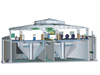
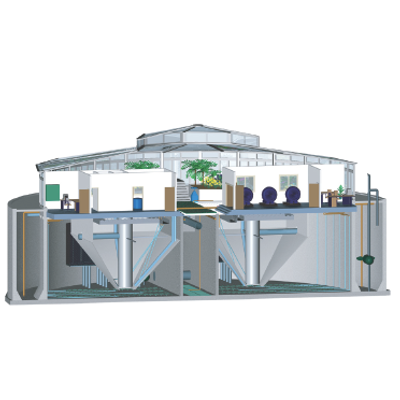
The structure technological unit has been integrated in a one tank built of reinforced concrete, in which all technological processes are going on, including monitoring, controlling, operation and waste product handling.
Separate operational areas are separated with divider walls made of reinforced concrete or plastics. Intercommunication of treatment culture media, treated water, arising sludge, and all energy channels (pressure air, electric power and water) are easy to follow and operate.
New generation of waste water treatment plants does not need complicated inner distributing piping; it has PC controlled media flows, thus handling was minimized, and the operation became absolutely dependable.
Biological treatment can be arranged according to the need either as one or two stage combined process, thus the process stability is increased. The use of solid bio-culture supports within the activation system increases treatment effect, improves separation of activated sludge, and enhances self-regulating properties of waste water treatment plants. Everything is done with a goal to enhance treatment process while making it simpler, reduce dependability on continuous checking, and prolong operating reliability and lifetime of technological units of waste water treatment plants.
The underground part of the structure is built of monolithic reinforced high-quality concrete while the aeration system itself is made of stainless steel, and it is completed with silicon diffusers. The overground part of the structure is mostly designed as a space glassed pavilion built of aluminium or aluminium-polyurethane sandwich panels, thus the life time of applied materials is maximal. Internal and external aesthetical look of the building positively influences public apprehension of waste water treatment plants.
-
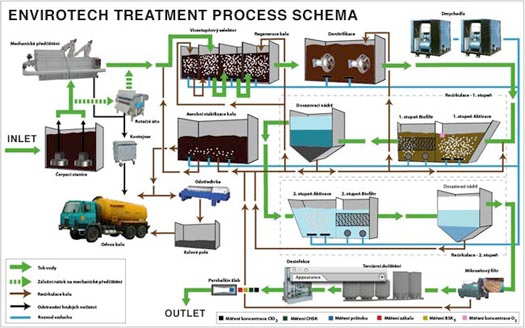
Affluent water comes through a stainless steel separator in which rough and floating impurities are separated, and then washed with treated water. Rakes are dewatered by pressing, and removed to a large-capacity container. In the area itself mineral impurities (sand and fine grit) are separated, and then removed to the sand container.
The complete unit - washing, aeration and transport of separated portion - is controlled by processor unit.
Redundancy (for the event of drop-out) is provided with a stainless drum filter, which stays during normal conditions in stand-by mode. -
Next, water flows into multistage (3 or 4 stages) aerobic selector of which task is to suppress the growth of fibre-form bacteria which can cause the washing out of the part of activated sludge (so called biological foaming in secondary settling tanks of waste water treatment plants).
-
Waste water coming into the selector is mixed with aerobically "regenerated" sludge that is pumped from the bottom of the secondary settling tank by means of controlled pump. The following aerobic regeneration improves physiological properties of activated sludge to be in good condition for further treatment process.
-
Then, the mixture of waste water and treatment culture flows into the denitrification area, where in anoxic environment (i.e. the environment in which the only source of oxygen is the oxygen contained in nitrates) and along with sufficient proportion of biologically easily decomposable pollution the biological denitrification is performed. The whole denitrification area is stirred, and in case the temperature falls under 10oC it is equipped with aeration diffusers.
-
Then, the main stream flows into the activation area which is considered the "heart" of the biological water treatment. The activation area has in advance calculated capacity of biological filters (honeycomb plastic carriers of biomass) which are regenerated in regular intervals. The combination of activated sludge and sessile bio-culture possesses a lot of technological advantages of which the higher concentration of treating culture is the most important as it provides the process with stability in case of material or hydraulic shocks as well as proven very high treating effect.
The activation area is provided with aeration stainless steel distribution system and silicone diffusers. That provides the system with a log service life and especially with high air-oxygen transfer into activation compounds, which results in lower energy requirements.
The big advantage of these waste water treatment plans is their design which enables flexible changes of operating mode, i.e. to switch between one or two stage operating mode. It is a unique technology that among other things benefits from the advantage of division of dominant bio-culture in activated sludge. Mainly bacterial bio-culture of the first stage is subsequently exchanged by mainly protozoa activated sludge. This type of treating process (in consequence of and depending on organic loading) has many advantages compared to "classic" one-stage processes without integrated carriers. Nevertheless, this technology can be easily operated as one stage while no "classic" water treatment plant can be operated in two-stage or combined mode without costly reconstruction. Accurate oxygen ratio and sludge removing are controlled by the computer through a series of sensors. -
Surplus of activated sludge is transferred into the area of aerobic stabilization (central part) from where it is led to the machined dewatering while the water is recycled back to the inlet of the water treatment plant.
-
Water from secondary settling tanks runs out through micro-screen which is able to eliminate dispersed particles bigger than 17 microns. The separated part is returned back to the area of aerobic stabilization.
Thus treated water runs through the area of continuous tertiary filters into the final disinfection area. -
Hygienisation itself is performed with chlorine dioxide. This proven and the most advanced disinfection process is in present perhaps the only and the most recommended way of disinfection of treated waters.
-
Automatic analysers monitor the quality of drained water and record basic characteristics in intervals set in advance. Data archival and instant visual checking of main nodal points is ensured by means of five cameras through the eternet bus to the monitoring and control station.
An automatic control system enables intervention into the automatic process and controls every electrically controlled device. The automatic control system follows operation status, visualises them for the operator, and in case of failure puts in operation reserve systems. Data and information are further distributed by GSM net or throughout internet.
The control system serves also as a protection facility.
So we introduce the modern concept of fully automated technology which guarantees attainment of all required parameters while ensuring minimum level of investment and operating requirements.