


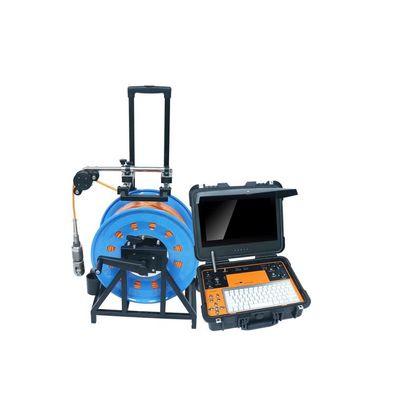
Granfoo - Water Well Inspection Camera
Borehole cameras have revolutionized the exploration and drilling industry by providing a visual representation of underground geology, rock formation, and other unexpected features. A borehole camera is a specialized piece of equipment used to capture live footage of the inside of a borehole, which is a deep hole drilled to explore for minerals, oil, or gas. There are many types of borehole cameras, with different capabilities and specifications, depending on the specific purpose for which they are being used. For instance, some can operate in extremely high temperatures and pressures or be used in highly corrosive substances. Generally, borehole cameras are made up of a camera head attached to a long flexible cable or a rigid pipe that can reach depths of up to several kilometers.
- 360-degree rotating camera, pan 360°, tilt 180°
- Chinese, English and other 9 languages are optional
- Screen Size:13"HD IPS LCD Screen, 1280X720 resolution
- Camera Size:1/3 CMOS,1.3MP pixel AHD 50mm PT camera head
- Cable Reel:7mm flexible cable &reel
- Power Supply:12V 8800mA Rechargeable
Why We Choose Borehole Cameras?
A borehole camera is an essential tool for subsurface imaging. It is used to inspect the internal condition of boreholes, wells, and other underground structures. A borehole camera involves inserting a camera into the borehole in order to capture images of the wall of the borehole. These images provide detailed information about the geology and hydrology of the subsurface geologic formations that cannot be obtained through direct observation.
1. Providing Detailed Information
The images produced by a borehole camera provide detailed information about the subsurface geologic formations. The images can tell the observer whether the borehole is vertical or inclined, whether the borehole has been properly sealed or not, and the type of geology that is present in the borehole. Such information can help geologists to determine the best location for water wells, for instance, by telling them about the thickness of the filter pack, or the depth at which water can be found.
2. Evaluating Groundwater Characteristics
The borehole camera also helps in evaluating groundwater characteristics within the borehole. The images produced give details about the borehole`s water zones and water levels. The information collected is helpful in groundwater assessment, exploration, and management.
3. Providing Valuable Data
Borehole cameras provide data that is valuable in making informed decisions on the management of resources, for instance, in controlling water pressure and enhancing water quality. This data helps in remotely collecting valuable information, which reduces the need for drilling multiple boreholes or carrying out a manual inspection of the boreholes.
4. Cost-Effective
Another advantage of borehole camera imaging is that it is cost-effective. With the use of borehole cameras, a geologist can obtain a clear picture of the subsurface geologic formations, which helps in reducing the cost of drilling multiple boreholes. The borehole camera also helps in remote data collection and in making informed decisions about groundwater management.
Borehole cameras are an essential tool in many industries. They provide many advantages, including the ability to detect problems, save time and money, improve safety, increase efficiency, protect the environment, and provide accurate data. It is clear that borehole cameras are an indispensable tool for any industry that relies on underground structures.
- 360-degree rotating camera, pan 360°, tilt 180°
- Chinese, English and other 9 languages are optional
- Screen Size:13"HD IPS LCD Screen, 1280X720 resolution
- Camera Size:1/3 CMOS,1.3MP pixel AHD 50mm PT camera head
- Cable Reel:7mm flexible cable &reel
- Power Supply:12V 8800mA Rechargeable