


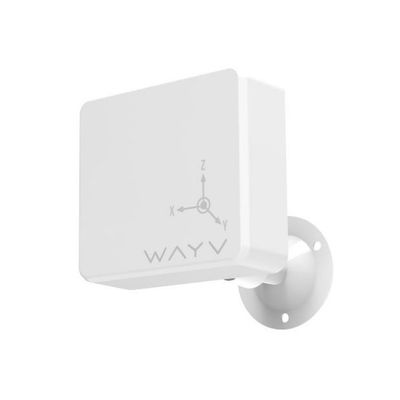
WAYV Air - Short-Range mmWave IoT Sensor for Open Spaces
WAYV Air is a short-range mmWave IoT Sensor designed specifically to collect and provide data about moving objects within a targeted area. It’s the perfect building block to develop innovative new applications for IoT and Smart City projects used to monitor Social Distancing, Space Utilization, Crowd Density Management, and Reducing Friction Points within Social Spaces.
No Camera in Sight
Because radar sensors do not use cameras or optical lenses, they are suitable for privacy-conscience applications such as restrooms—they can even be installed behind the ceiling or wall, to improve aesthetics and further reduce privacy concerns.
While cameras are good at recording what’s happening, radar provides data points such as presence information, the number of people in a given area, where people are located within the sensor field-of-view, as well as the distance between people. This data can be aggregated and analyzed to gain insights on crowd density and visitor traffic flow.
Through an interactive display, our technology lets users and managers understand the occupancy of the room. This improves the experience of the users and the cleaning management of the room.
Operations managers can anticipate and mitigate transmission risks before they happen. By knowing the real-time occupancy and utilization of gyms, conference rooms and other common amenity spaces, staff can manage occupancy to maintain social distancing, adjust cleaning services, food and beverage, and staffing to match real-time attendance.
Join the WAYVThe WAYV Air has already been successfully applied to a number of smart projects for occupancy detection and human flow statistics. Our customers are extremely pleased over the WAYV Air’s accuracy, low cost, low power and easy installation.
Because radar sensors do not use cameras or optical lenses, they are suitable for privacy-conscience applications such as restrooms—they can even be installed behind the ceiling or wall, to improve aesthetics and further reduce privacy concerns.
While cameras are good at recording what’s happening, radar provides data points such as presence information, the number of people in a given area, where people are located within the sensor field-of-view, as well as the distance between people. This data can be aggregated and analyzed to gain insights on crowd density and visitor traffic flow.