


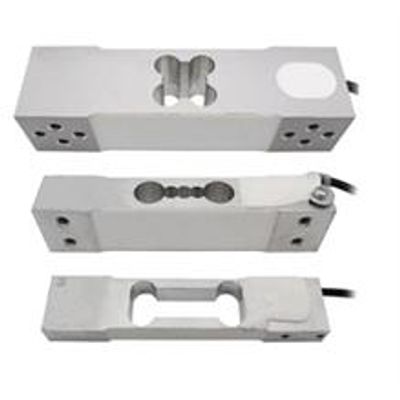
ATO - Model S-LCB-DYX-306 -Weighing Scale Single Point Load Cell
Single Point Load Cell 300g/1kg/20kg/100kg/300kg for Weighing Scale. Single point load cell is the most common load cell for weighing scale in the market. In the early 1980s, in order to cope with the contradiction of requirements (small range, large stiffness and high accuracy) of the electronic price computing scale for commercial use, elastic elements adopt the multibeam structure with a low appearance and a small percentage of materials.
The Eρ product is small, the yield rate is high, the specific strength is large, the plasticity is good, and the low-temperature performance is good. Meanwhile, there is 2A12 aluminum alloy with a low elasticity modulus with a favorable mechanical processing performance. The single point load cell with varied structural types, including aluminum alloy parallel beam, central beam, and central ring, have been subsequently developed. Its mechanical characteristic is to generate the bending stress (or normal stress) generated by combination between the upper stress beam and the flexible beam of elastic elements. Though the bending stress is used, multiple parallel beams have their mechanical characteristics. Therefore, loading point changes of elastic elements show poor sensitivity towards output. In other words, the structure of bending stress has the structural characteristics of the shear stress. Therefore, single point load cell has found wide applications in the electronic price computing scale and the electronic portable platform and bench scale. Similar to the shear elastic elements of load cell, a new development trend has been formed for the normal stress parallel beam elastic elements. Various elastic elements with a parallel beam are presented in figure 1.
- Capacity. 300g, 600g, 1kg, 2kg, 3kg, 6kg, 10kg, 20kg, 40kg, 100kg, 200kg, 300kg, 500kg
- Accuracy. 0.02~0.03%F.S (linearity + hysteresis + repeatability)
- Sensitivity. 2.0±0.05mV/V
- Creep. ±0.02~±0.03%F.S/30min
- Zero output. ±1%F.S
- Temperature effect on zero. ±0.03%F.S/10℃
- Temperature effect on output. ±0.03%F.S/10℃
- Operating temperature. -20℃~+65℃
- Input impedance. 350±20Ω
- Output impedance. 350±5Ω
- Insulation resistance. ≥5000MΩ
- Safety overload. 150%F.S
- Bridge voltage. DC 10-15V
- Material. Aluminum alloy
- Protection class. IP67