


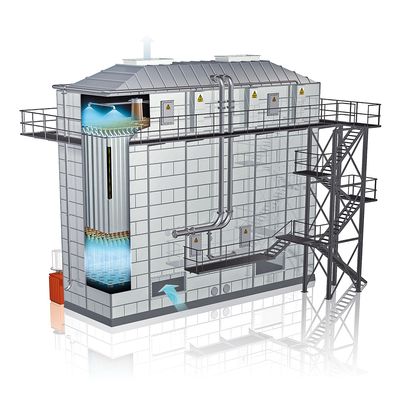
R&R-BETH® - Model ESP -Wet Electrostatic Precipitator for Air Pollution Control
The R&R-BETH® Wet Electrostatic Precipitator (ESP) is engineered for superior removal of submicron particulates, heavy metals, and condensed fumes in industrial settings. Offering a 99% efficiency rate in a single stage, this technology is essential for applications where traditional air pollution controls like dry ESPs or baghouses struggle with fine particulates. Its method entails an electrical charge applied between spray electrodes and honeycomb collecting electrodes, attracting particles that are then washed into a sump. Tailored to handle gas streams at differing temperatures with optional cooling modules, the device's optimal material selection enhances durability and corrosion resistance. Delivering energy-efficient operation with low pressure drops, the unit supports emission compliance and enables process gas finishing before further treatment. It is highly beneficial in sectors requiring advanced aerosol separation at industrial scales.
The WET Electrostatic Precipitator (ESP) from R&R-BETH® delivers exceptional efficiency in controlling submicron particulates, heavy metals, acid mists, and condensed metal fumes and organics. With a removal capacity of up to 99% in a single stage, this advanced technology is ideal for industrial and utility applications. It excels as a final polishing solution, particularly where other air pollution control systems, such as dry ESPs, baghouses, or wet scrubbers, struggle to capture fine particulates. Beyond reducing emissions and stack opacity, it also enables valuable product recovery from process gases, making it a versatile and sustainable choice for air quality control.
The process gas enters the ESP vertically from the bottom, where it is evenly distributed across the filter's entire cross-section using a gas distribution system. High voltage (78-135 kV) is applied between spray electrodes and honeycomb collecting electrodes, electrically charging the particles, aerosols, and water droplets. As these charged particles pass through the electric field, they are attracted to the collecting electrodes, where they combine with existing dust particles. A periodic flushing system then washes the dust-water mixture into the filter sump below the gas intake. Finally, the purified gas exits through the gas outlet hood at the top of the filter.
Versatile Application Range
R&R-BETH provides WET ESP solutions for gas flow rates ranging from 1,000 to 500,000 m³/h (590 to 294,300 CFM). The standard models are designed to handle gas streams up to 75°C (167°F). For processes with higher temperatures, R&R-BETH offers optional cooling modules to ensure optimal performance across a wide range of applications.
Ultra Low Maintenance with Optimal Material Selection
R&R-BETH's WET ESPs are designed for minimal maintenance through the careful selection of materials tailored to each application's unique conditions. By analyzing process gas characteristics, pH levels, and chloride content, R&R-BETH recommends construction materials ranging from carbon steel and stainless steel to FRP and high-end alloys. This ensures long-lasting durability, corrosion resistance, and reliable performance, customized for the specific needs of each industry and plant.
Exceptional Ultra-Fine Particle Separation
Our WET ESPs effectively capture ultra-fine particles and coarse droplets from upstream systems such as scrubbers, dryers, or quenches, ensuring compliance with legal emission limits. This advanced technology delivers optimal aerosol separation and removes even the most critical respirable dust particles with extremely low settling velocities. R&R-BETH WET ESP are ideal for gas polishing as well, preparing it for further downstream treatments, e.g. RTO systems.
Energy Efficient Design
Featuring an exceptionally low pressure drop of less than 250 Pa (1 in. wg), our WET ESPs are engineered for superior energy efficiency, reducing operational costs while maintaining optimal performance.