- Home
- Companies
- Fulcrum3D P/L
- Products
- Fulcrum3D - Model Sodar - Wind ...
Fulcrum3D - Model Sodar -Wind Monitoring System
Accurate, flexible, cost effective wind monitoring which meets the requirements of the wind energy industry. Accurate wind data is essential in financing and operating wind farms. The Fulcrum3D Sodar is specifically designed for the wind energy industry to deliver visibility of the wind profile on site. The unique design of the Fulcrum3D Sodar delivers excellent performance in complex or simple terrains. Providing insights into the wind profile in various conditions and assessing sites for development suitability are some of the benefits of the Fulcrum3D Sodar.
Fulcrum3D Sodar uses proprietary technology housed in a robust and portable unit. What makes the Fulcrum3D Sodar unique includes:
- Accurately measuring and reporting wind speeds;
- Assessing site performance;
- In three dimensions;
- Up to 200m above ground level;
- Delivering data consistency, traceability and processing managed by secure servers;
- Low cost;
- Flexible deployment.
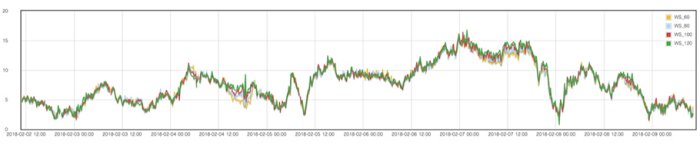
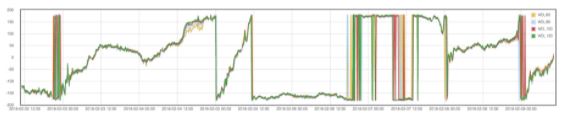
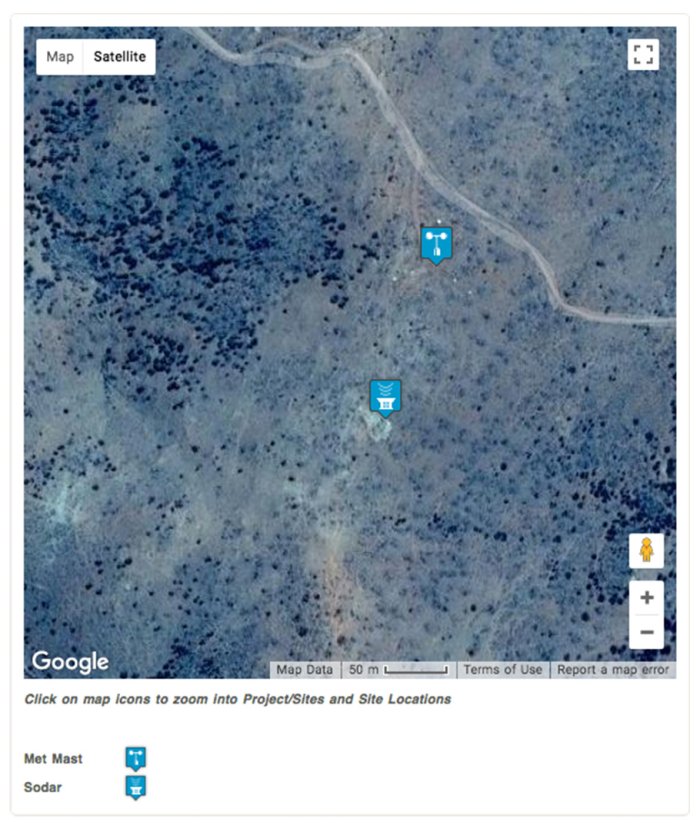
The Fulcrum3D Sodar is more flexible than a Met Mast, and lower cost than a Lidar. The Fulcrum3D Sodar provides data on wind conditions including wind speed, wind direction, wind speed vector standard deviation and inflow angle (related to vertical wind speed). Data from optional sensors such as temperature, humidity, pressure, solar radiation etc. is also provided.
Fulcrum3D Sodar is the best priced Sodar on the market. The flexibility of the Fulcrum3D Sodar and its optional equipment adds significant value to your development, operational performance or other applications.
ALL Fulcrum3D Sodar packages include these base functionalities
- 3D wind data (speed, direction and inflow angle) from 40m to 200m in 10m range bins
- Vaisala HMP60 (temperature, humidity) sensor, upgradable to WXT520 multi-weather sensor
- GPS for security, tracking and geofencing
- Solar power supply and remote communications (GSM 3G/4G, satellite optional)
- Flightdeck access to all data – remote and 24/7
Fulcrum3D Sodar delivers precise, validated and bankable wind data
Validation by DNV-GL, Parsons Brinckerhoff, Entura.
DNV GL accepts Fulcrum3D Sodar data in bankable wind energy assessments on benign sites.
Flexible and simple
Generally does not require a planning permit to install, enabling more data captured and faster. The easily portable unit allows monitoring at a number of locations around your site to significantly reduce uncertainty.
Terrain flexible
Performs well in complex and simple terrain and housed in a robust, portable unit.
Cost effective and efficient deployment
More flexible than a Met Mast, lower cost than a Lidar. Significantly cheaper than a Hub Height Mast – in some cases half the cost.
24/7 online access to your data, manage your equipment
FlightDECK collects, stores and verifies your data for secure, fast download for self managed equipment locations and configurations.
Full data traceability
Incorporates fully traceable data architecture, sending all raw sound spectrum data to the Fulcrum3D servers for off-site processing while saved in secure back-up storage.
The Fulcrum3D Sodar is the best system to provide high quality wind data for a variety of applications, for example:
- Resource assessment – prospecting for sites and proving wind resource;
- Power curve verification – confirming turbine performance in a variety of wind conditions;
- Performance monitoring – maximise the long term performance of your asset;
- Wind forecasting – for energy sales or optimising network integration.
Fulcrum3D Sodar a unique design with superior functionalityDesign
The Fulcrum3D Sodar is unique in its design.
- By covering the entire turbine area, Fulcrum3D Sodar has a significant advantage over traditional wind monitoring equipment using masts.
- A compact-beam Sodar which uses mechanically fixed beam angles to maximise accuracy and reliability of results. The beam geometry is optimised for use in both flat and complex terrain where traditional Sodars lose accuracy due to the variable wind vectors over the sensed air volume
- The physically fixed beam angles eliminate errors introduced in electronically steered Sodars, where the steering frequency must be adjusted to take into account local temperature effects. In addition to eliminating temperature related errors, this minimises side lobes and therefore allows for a more compact system
- The Fulcrum3D Sodar design allows multi-beam sampling where all three beams can be sampled simultaneously. This effectively triples the sampling rate and can significantly improve data accuracy and availability
- The Fulcrum3D Sodar is software defined and fully flexible – all the data analysis intelligence is held on the server-side rather than on-board the Fulcrum3D Sodar unit, so the operating algorithms and software upgrades can be remotely applied for optimum results
- Auxiliary sensors can be added and operating frequency changed to allow multiple units to be co-located without interfering with the performance of others.
Functionality
A standard Sodar works by sending out a sound pulse (beep) and listening to the returned sound signal as it’s scattered back towards the Sodar by atmospheric turbulence. You can listen to the sound pulse here. The principle, is similar to Radar.
The three sound beams of the Fulcrum3D Sodar allow a three dimensional wind vector to be measured. After the pulse is transmitted, the Fulcrum3D Sodar begins recording the returned sound signal and various filtering techniques are used to eliminate false data, background noise, errors introduced from rainfall and other factors.
The Fulcrum3D Sodar measures wind speed, direction and inflow angle in 10m height intervals from 40m to 200m above ground level, which aligns with the height of modern wind turbines. For each height range, data quality and other measurement statistics are calculated every 10 minutes.
The wind speed, direction, inflow angle, and height range are then calculated based on:
- The time delay from when the beep was transmitted to when it was received, which indicates the sampling height (based on the speed of sound);
- The change in frequency between the transmitted and received sound on each sound beam, which is caused by the wind vector along each beam axis (due to the Doppler effect);
- The known angles of the three sound beams, together with the wind vector along each beam, which is interpreted to produce a three dimensional wind vector.
This wind vector is then translated into wind speed, direction, and inflow angle in each height bin. More complex analysis allows the wind speed standard deviation and turbulence index to be calculated. The Fulcrum3D Sodar transmits a sound pulse approximately every 1.5 seconds, giving a large number of samples which are then analysed to generate 10 minute statistics.
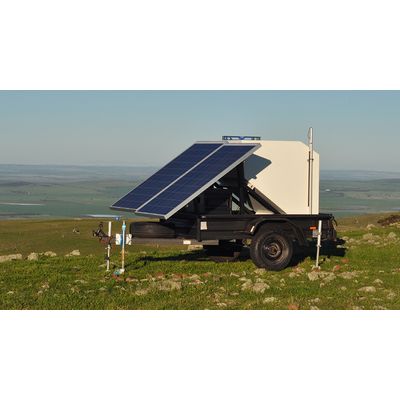
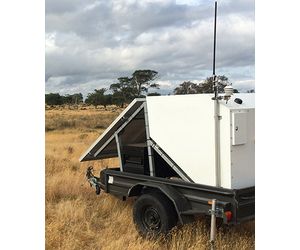
The Fulcrum3D Sodar is a portable unit, mounted on a standard box trailer, and powered by its own low-maintenance solar battery system. It is supplied with on-board remote telemetry, for a set-and-forget solution which reliably provides accurate data to your desktop.