


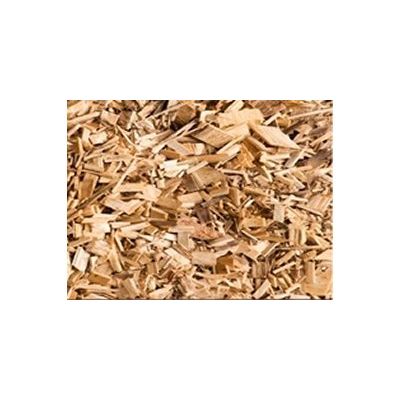
Wood Chips
Wood chips are usually made from harvested wood from forestry and clean waste wood from timber related production. Wood chips are readily available locally and usually transported in bulk loads at regular intervals but they can be chipped on site using specialist machinery if the user has its own supply of wood stock. They need to be stored under cover to ensure that the moisture content remains low as this affects the boiler efficiency.
Particle size and moisture content are the critical elements to consider:
Particle size is important for transporting between bunker and combustion chamber and also for the efficiency. Particle size needs to be matched to the boiler to ensure efficiency. Slivers in the fuel must be avoided when using augers to transport the fuel – belt conveyor/hydraulic push feed systems would be better suited to these
The most common specification is for wood chip dried to below 30% moisture content. A boiler’s output is only usually guaranteed for fuel up to this moisture content (although specific to each manufacturer). Wood chip up to 55% moisture content can be used and is a low cost fuel option but requires a specialised boiler to combust it efficiently.
In summary:
- Cheap fuel source, especially if waste wood already available on site
- Lower cost than wood pellets
- Although wood chip is a cheap option, it is not always the most suitable fuel for biomass boilers due to its variable moisture content and irregular particle size.
- Needs larger storage bunkers than wood pellets (up to 7 times greater than wood pellet)
- Wood chip sweep arm agitator system would be required to ensure that it remains free flowing when in the fuel bunker or a hydraulic moving floor incorporated in a feed system to deliver it to the boiler. Therefore can be higher capital cost
- Due to their nature, boiler can incorporate fully automated ignition complete with ash removal and modulating control