


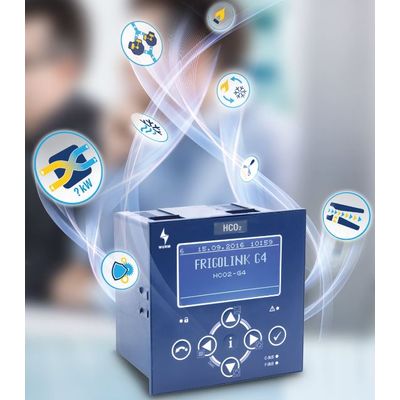
WURM - Model HCO2-G4 -Flexible Solution For CO2 Plants
Due to stricter requirements for climate protection, operators of refrigeration and building control systems are increasingly using natural refrigerants such as R744 (CO2). The number of transcritical CO2 plants is rising. Wurm has continuously been developing technology for the controlling of transcritical CO2 plants since 2006. Current trends such as ejectors and integrated systems are, of course, important parts of our constant further developments.
Our experience gained over years has now been incorporated into the development of our new master module, HCO2-G4. This comprehensive solution is highly scalable according to your specific requirements. You can use it for various tasks such as parallel compression, ejectors, heat recovery or air conditioning.
Heat recovery (HR) with HCO2
Heat management belongs to the key tasks of economically and ecologically efficient plant operation. Due to its multitude of functions, HCO2-G4 is flexible to use under different operating conditions. For example, you can control two complete units that generate heat for heating water and heated process water at the same time. Further heat sources can also be used and controlled. Thanks to needs-based heat recovery with HCO2-G4, the entire waste heat of the refrigeration plant stays in the system and you can significantly increase the energy efficiency of your plant.
Heat volume calculation
One of the outstanding features of HCO2-G4 is its integrated heat volume calculation without additional sensors. All relevant information is already available in the control system. Analysis and evaluation of the heat recovery is executed in combination with our web-based platform FRIGODATA ONLINE. Operation times and malfunctions are considered, too. Increased HR transparency enables faster fault analysis and troubleshooting.
Ejectors
With HCO2-G4, plant concepts can also be realized with both stepped and continuous ejectors for transporting gas and liquid.
Ejectors influence the pressure level in the respective refrigerant circuit (gas or liquid medium). The work done during this process (Venturi principle) can be used in different ways and thus contribute to increasing the energy efficiency of your plant.