- Home
- Companies
- Yeasen Biotechnology (Shanghai) ...
- Products
- Yeasen - Model 36701ES59 - ...
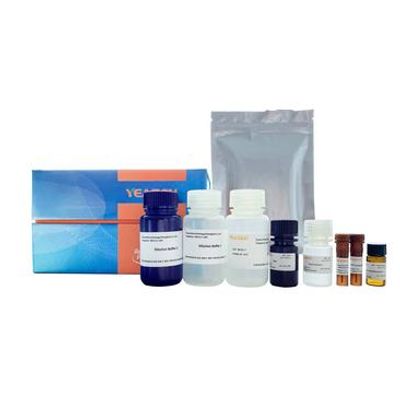
Yeasen - Model 36701ES59 -UltraNuclease ELISA Kit
UltraNuclease, also known as a non-restrictive endonuclease, broad-spectrum nuclease, is a non-specific endonuclease derived from Serratia Marcescen, which hydrolyzes internal phosphodiester bonds between any nucleotides in nucleic acids to produce 5`-monophosphate oligonucleotides of 2-5 bases in length. It can degrade DNA and RNA in various forms (double-stranded, single-stranded, linear, circular, native or denatured) under a very broad range of conditions (6 M Urea, 0.1 M Guanidine HCl, 0.4% Triton X-100, 0.1% SDS, 1 mM EDTA, 1 mM PMSF) and is widely used to remove nucleic acids from biological products. UltraNuclease can also be removed by corresponding methods subsequently.
This kit uses the principle of double-antibody sandwich enzyme-linked immunosorbent assay (sandwich ELISA) to detect the residues of denatured and non-denatured UltraNuclease. First, coat the microplate with an anti-UltraNuclease rabbit polyclonal antibody to form a solid-phase antibody. Second, add UltraNuclease standard and test sample to the solid-phase antibody microplate, then add biotin labeled Anti-UltraNuclease polyclonal antibody, and finally, add horseradish peroxidase-labeled streptavidin (SA-HRP) to form an antibody + antigen + antibody-Biotin + SA-HRP complex. Subsequently, TMB substrate was added to the complex to observe the color reaction after washing the complex. TMB is converted into blue under the catalysis of the HRP enzyme and finally converted into yellow in the presence of an acid, and the shade of color is positively correlated with the amount of UltraNuclease in the sample.
Shipping and Storage
The UltraNuclease ELISA kit is shipped with an ice pack and can be stored at 4°C. Unopened product is valid for one year. Once the reagent is opened, it is valid for half a year. Never freeze this product.
Storage of the prepared reagents:
- The diluted washing buffer and dilution buffer can be stored at 4°C for 1 week.
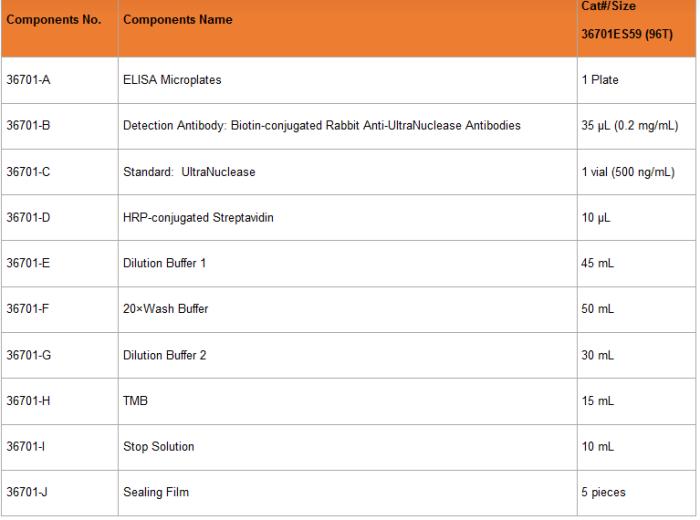
- Standard 36701-C is liquid and stored at 4°C for 1 year.
- Prepared detection antibody and stop buffer can be stored at 4°C for 1 month.
Cautions
- The kit needs to be used up within its shelf life. Mixing of related reagents from different batches is prohibited.
- The kit is designed for detecting the target antigens and samples marked in the instructions only. Other applications need to be designed and verified by the user, and the reliability and accuracy should be evaluated based on the results.
- For your safety and health, please wear personal protective equipment (PPE), such as laboratory coats and disposable gloves, when operating with this product.
- This product is for research use ONLY!
Instructions
Reagent preparation
- All reagent components and samples to be tested need to be returned to room temperature before use.
- Preparation of 1× Wash Buffer: equilibrate the concentrated solution to room temperature and dissolve it fully without crystals. Mix well and transfer 50 mL of 20× Wash Buffer into container, and then bring the volume to 1 L with ultrapure water. the specific volume can be prepared according to the amount used each time.
- Preparation of Detection Antibody: centrifuge at 10,000 rpm for 20 secs before use, and then dilute the detection antibody to a working solution concentration of 0.5 μg/mL with Dilution Buffer 2.
- Preparation of HRP-conjugated Streptavidin: centrifuge at 10,000 rpm for 20 secs before use, and then dilute the HRP-conjugated Streptavidin to the working concentration by 1:5000 dilution with Dilution buffer 2.
- Preparation of the standard curve: prepare 8 sterile 1.5 mL centrifuge tubes and label them sequentially according to the standard concentration. Pipette 994 μL of Dilution Buffer 1 to the centrifuge tube marked 3 ng/mL, and pipette 500 μL to the other tubes. Transfer 6 μL of 500 ng/mL UltraNuclease Standard to the centrifuge tube marked 3 ng/mL and mix well, then transfer 500 μL to the centrifuge tube with the next labeled concentration, mix well, and perform a series of 2-fold gradient dilutions of the standard. It can be carried out according to the following table and the initial maximum concentration is 3 ng/mL, and the minimum is 0.047 ng/mL. A corresponding standard curve needs to be prepared for each test, and standard curves of different kits and different times cannot be mixed. For sample testing, the required standard volume for each well is 100 μL. Note that the preparation volume should be higher than the required volume to avoid insufficient volume.