- Home
- Companies
- Yokogawa Electric Corporation
- Products
- Yokogawa - Model FLXA202 - 2-Wire Dual ...
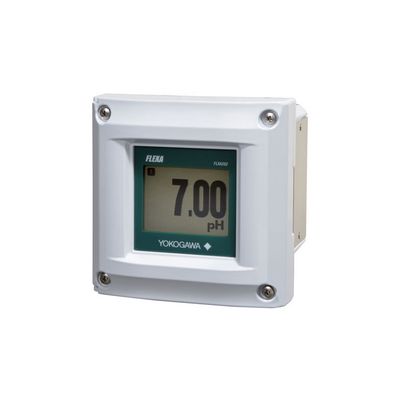
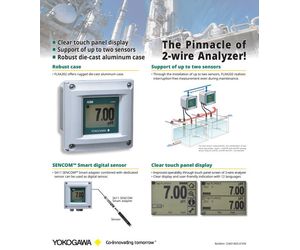
Yokogawa - Model FLXA202 -2-Wire Dual Channel Transmitter/Analyzer
With the FLXA202, one analyzer can accept any of four types of measurements: pH/ORP, Contacting Conductivity (SC), Inductive Conductivity (ISC) and Dissolved Oxygen (DO) Sensors with self-diagnostics capabilities. Additional functions include:- Continuous measurement of sensor impedance, asymmetric potential, and slope, and continuous monitoring for electrode contamination/damage, burnout, and decline in measurement liquid level (ex. pH Analyzer).
- Online Sensor Wellness checking for predictive maintenance.
For more information: https://www.yokogawa.com/solutions/products-and-services/measurement/analyzers/liquid-analyzers/conductivity-analyzers/two-wire-transmitter-analyzer-flxa202
Clear Touch Panel Display for Improved Operability
The FLEXA™ series analyzer provides improved operability with intuitive touchscreen operation, featuring a clear display and user-friendly indication with 12 languages. A quick setup menu for immediate measurement and a display of sensor status and estimated maintenance time improve efficiency. The interactive screen is housed in a robust aluminum die-cast housing (FLXA202).
Modular Design for Increased Scalability
The FLEXA™ series analyzer features a modular design with replaceable sensor modules, enabling the construction of a variety of systems. Users can opt to do without a display and can also select the case material (plastic or stainless steel).
Achieves high-precision pH measurement
- Built-in calibration standard table with temperature compensation function and stability check function.
- The detector status is checked and monitored in real time.
- Temperature and oxidation-reduction potential (ORP) can also be measured.
- Continuously measures the impedance, asymmetric potential, slope, etc. of the detector to continuously self-diagnose the status of the detector, such as contamination/damage, disconnection of the electrode, lowering of the measuring liquid level, etc.
- Save the latest five calibration results to predict the health of the detector and future maintenance and calibration timing.
Realize highly versatile and high-precision Conductivity / Resistivity measurements
- The built-in temperature compensation function and calibration standard table enable higher-precision conductivity measurement by monitoring the contamination of the cell.
- Cell constants correspond to 0.005 to 50 cm-1.
- Both 2-electrode and 4-electrode sensors can be used.
- Five types of temperature detectors are supported, and accurate temperature compensation (linear temperature compensation/matrix temperature compensation) is performed.
- Pure water and compliance with stringent standards for WFI monitoring (USP item <645>)
- In the analysis of demineralized water, steam, condensate, and boiler water, pure water compensation is performed.
- Monitors the quality of the process solution in accordance with the USP (U.S. PHARMACEUTICAL) entry <645> (see Section 645 of USP23) guideline (U.S. PHARMACEUTICAL GUIDE), which serves as the basis for monitoring pure water in the PHARMACEUTICAL INDUSTRY.
Benefits of Inductive Conductivity Measurement
- Strong acid and strong alkali are also measured, and high-precision measurement with confidence is available for a wide range of applications.
- For non-contact measurement, it is subject to measurement from acid and alkaline solutions to salt-containing solutions.
- It has a matrix compensation and output linearization function to accurately analyze solutions of strong acid and strong alkali.
- Level monitoring in the chemical industry, food and chemical industries, plating and surface treatment industries, paper and pulp industries, etc. makes measurements of electromagnetic conductivity for a wide range of applications with high accuracy.
- One 4-20 mA output for recording, display, and control.
- Select the measurement parameter from Conductivity, Level or Temperature.
- Only one sensor can be connected.
Benefits of Dissolved Oxygen Measurement
- Process Analyzer with High Functionality, High Reliability, and Reduced Maintenance
- Can be used under severe environmental conditions and is ideal for on-site installation
- Either galvanic or polarographic sensors can be used.
- Indicated units are mg/L, ppm and % saturation.
- Corrections are made for changes in atmospheric pressure, salinity, and temperature depending on altitude, etc., even in harsh environments.
- High-precision measurement is possible.
- One 4-20 mA output is provided for recording, display, and control.
- Concentration, temperature or calculated values of the two detectors, plus the following output functions are also configurable: Hold function: Hold the output signal to the last measured value or fixed value (hold).
- Burnout function: Burn-up (22.0mA) or burn-down signal (3.6 mA) is output in case of failure.
- Compatible with various other types of explosion-proof
- Monitoring performances of cation exchange columns (Ratio output).
- Leak detection of heat exchanges (Deviation output).
- Monitoring performance of reverse osmosis columns (Percent rejection output).
- Controlling flowrate of wash water (Differential output).
- Controlling blow-down of cooling towers (Ratio output).
- Redundancy for accurate analysis (Deviation output).
- Monitoring very high purity systems (Differential Resistivity).
- Pharmaceutical water monitoring (USP<645>).
Common Specification
Area Classification
General Purpose
Class I Div II (without the use of IS Barrier)
Class I Div I (with the use of IS Barrier)
Enclosure Material
Aluminum alloy die cast with epoxy coating (Standard offering
Aluminum alloy die cast with urethane or high anti-corrosion coating (available upon request)
Housing Rating: IP66 (except Canada), Type 4X (except Canada), Type 3S/4X (Canada)
Power Supply: 2-wire 24VDC Loop Powered
Output Signal: Bi-directional HART digital communication, superimposed on mA (4-20mA) signal
Intrinsically safe type: ATEX, IECEx, FM, CSA and NEPSI, and nonincendive of FM and CSA
pH / ORP Measurement Specification
Input Range
pH: -2 to 16 pH (with option /K: 0 to 14 pH)
ORP: -1500 to 1500 mV
rH: 0 to 100 rH
Temperature: Pt1000, Pt100, 6.8k, PTC10k, 3k Balco, PTC500: -30 to 140 ºC, NTC 8k55: -10 to 120 ºC
Performance (The specifications are expressed with simulated inputs.)
pH: Linearity: ±0.01 pH, Repeatability: ±0.01 pH, Accuracy: ±0.01 pH
ORP: Linearity: ±1 mV, Repeatability: ±1 mV, Accuracy: ±1 mV
Temperature with Pt1000, PTC500, 6.8k, PTC10k, NTC 8k55, 3k Balco: Linearity: ±0.3 ºC, Repeatability: ±0.1 ºC, Accuracy: ±0.3 ºC
Temperature with Pt100: Linearity: ±0.4 ºC, Repeatability: ±0.1 ºC, Accuracy: ±0.4 ºC
Conductivity / Resistivity Measurement Specification
Input Specification: Two or four electrodes measurement with square wave excitation, using max 60m (200ft) cable (WU40/WF10) and cell constants from 0.005 to 50.0 cm-1
Display range:
Conductivity: min. 0.01 µS/cm, max. 2000 mS/cm (max 90% zero suppression)
Resistivity: min. 0.001 kΩ x cm, max. 1000 MΩ x cm (max 90% zero suppression)
Temperature: min. span 25 ºC, max. span 270 ºC
Performance (Accuracy)(The specifications are expressed with simulated inputs.):
Conductivity:
2 µS x K cm-1 to 200 mS x K cm-1: Accuracy: ±0.5%F.S.
1 µS x K cm-1 to 2 µS x K cm-1: Accuracy: ±1%F.S.
Resistivity:
0.005kΩ / K cm-1 to 0.5MΩ /K cm-1: Accuracy: ±0.5%F.S.
0.5MΩ / K cm-1 to 1MΩ /K cm-1: Accuracy: ±1%F.S.
Temperature
with Pt1000, Pb36, Ni100: Accuracy: ±0.3 ºC
with Pt100, NTC 8k55: Accuracy: ±0.4 ºC
Temperature compensation
NaCl table: ±1 %
Matrix: ±3 %
Temperature: 90 % (< 2 decades) in 7 seconds
Inductive Conductivity Measurement Specification
Input Specification: Compatible with the Yokogawa inductive conductivity ISC40 series with integrated temperature sensor: NTC30k or Pt1000.
Input Range
Conductivity: 0 to 2000 mS/cm at 25 ºC reference temperature.
Temperature: -20 to 140 ºC
Cable length: max. 60 meters total length of fixed sensor cable + WF10(J) extension cable. Influence of cable can be adjusted by doing an AIR CAL with the cable connected to a dry cell.
Performance (The specifications are expressed with simulated inputs.)
Conductivity:
Linearity: ±(0.4 %F.S. + 0.3 µS/cm)
Repeatability: ±(0.4 %F.S. + 0.3 µS/cm)
Temperature: ±0.3 ºC
Step response: 90 % (< 2 decades) in 8 seconds
Dissolved Oxygen Measurement Specification
Input Specification: The FLXA202 accepts output from membrane covered Dissolved Oxygen sensors. These sensors can be Galvanic type, where the sensor generates its own driving voltage or Polarographic type, where the sensor uses external driving voltage from the converter.
The input range is 0 to 50 µA for Galvanic sensors and 0 to 1 µA for Polarographic sensors.
For temperature compensation, the FLXA202 accepts Pt1000 (DO30 sensor) and NTC22k elements (OXYFERM and OXYGOLD sensors).
Measurement Range
DO Sensors: Dissolved Oxygen: 0 to 50 mg/l (ppm), Temperature: -20 to 150 ºC
DO30G: Measurement range: 0 to 20 mg/l (ppm), Temperature: 0 to 40 ºC
Performance (Accuracy) (Performance in ppm mode):
Linearity: ±0.05 ppm or ±0.8% F.S., whichever is greater
Repeatability: ±0.05 ppm or ±0.8% F.S., whichever is greater
Accuracy: ±0.05 ppm or ±0.8% F.S., whichever is greater
Temperature: Linearity: ±0.3 ºC, Repeatability: ±0.1 ºC, Accuracy: ±0.3 ºC