


- Home
- Companies
- Dispersion Technology, Inc. (DTI)
- Products
- DTI - Model Zeta - DT-300 - Zeta ...
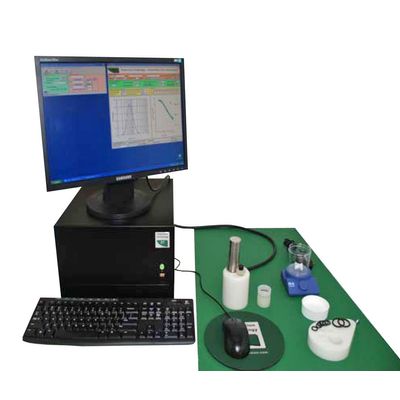
DTI - Model Zeta - DT-300 -Zeta Potential Probe
Model DT-100 has a unique Acoustic sensor for characterizing particle size distribution by measuring ultrasound attenuation at set of frequencies from 1 to 100 MHz, as well as sound speed. This method can be referred to as “ultrasound scattering”.
These instruments have Zeta potential probe that allows characterizing concentrated dispersions and emulsions with no dilution. They yield information on the following parameters:
- zeta potential in concentrated dispersions and emulsions when volume fraction >1 %
- electric surface charge density when conductivity known
- iso-electric point when model DT310
- optimum dose of surfactant
- sedimentation stability of the sample
- presence of small amounts of large sedimenting particles
Zeta potential probe can be simply inserted into the sample. Alternatively, a plastic cup on the top face of the probe serves as a sample holder. Accordingly, the sample volume in this setup is under 1 ml.
There are several options available for this instrument. Conductivity probe allows monitoring ionic strength and estimate Debye length when samples are aqueous. In case when samples are non-aqueous, standalone instrument DT700 yields conductivity for such calculations. Temperature and pH probe are also optional.
- no dilution when volume fraction up to 50%
- less sensitive to contamination
- higher precision (± 0.1 mV)
- low charges (down to 0.1 mV)
- electro-osmotic flow is not important
- convection is not important
- accurate for non-aqueous dispersions