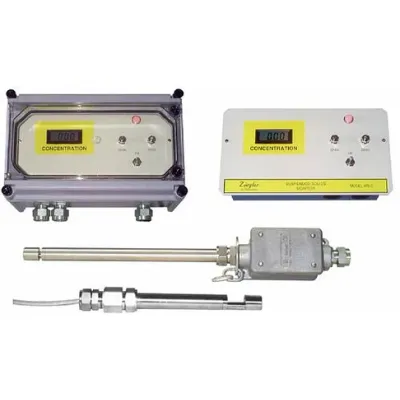
The Model 978-C is a rugged inline suspended solids monitor that monitors total suspended solids (TSS) in process pipes, open channels or tanks. Our inline measurements assure instantaneous response, maximum accuracy and highest reliability without costly bypass systems. The monitor can be scaled from as low as 0-2000 PPM to as high as 0-20% TSS.
Easy Installation
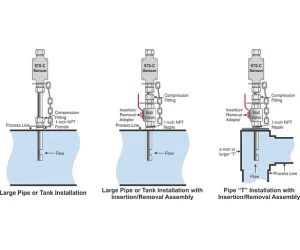
Initial installation of our insertion sensor is as easy as installing a 1-inch female NPT fitting in the process piping. The submersible sensor can be suspended by its cable. Once installed, both suspended solids sensors can be inserted and removed without interrupting process flow.
Wide Dynamic Range
Our suspended solids monitor can be scaled from as low as 0-2000 ppm to as high as 0-20% TSS. The 0-2000 ppm range gives low level readings with high resolution for use downstream of clarifiers or on raw water supply. Ranges above 2000 ppm can be used for measuring high concentration solids or detecting sludge levels in clarifiers.
Instantaneous Response
Because the sensor optics are in the process stream, the Model 977-C suspended solids monitor does not require bypass systems. Our in-stream measurement eliminates slow response times inherent with TSS monitors requiring bypass plumbing. The Model 977-C is extremely effective in streams, rivers, and lakes and in processes where filter monitoring is crucial, and efficiency or breakthrough must be detected quickly.
Industrial Applications Include:
- Potable water
- Wastewater
- Dairy
- Mining
- Chemical
- Food and beverage
- Breweries
- Pulp and paper
- Petrochemical
- Forestry
- Environmental
Ready to Order?
Installation & Instruction Manual
- 978-C Installation Manual (current model, serial #1178 and higher)
- 978-C Installation Manual (older model, serial #1177 and lower)
There are no restrictions on the maximum pipe diameter into which the sensor can be installed. However, if a 2-inch or smaller line is to be monitored, install a 2-inch or larger “T” to prevent the sensor from blocking the line.
While any position on the periphery of the process pipe may be used to install the sensor, a position above the horizontal plane is recommended, particularly if the sensor is to be removed frequently. The sensor may either be installed through a "T" or a weldment that has been installed on the process pipe.
An insertion depth between 1" and 4" is suggested. If the process pipe is empty or filled with a clean fluid, position the sensor at a depth where a minimum reading is obtained on the meter. This is to assure that any internally reflected light from the process piping can be zeroed out. To further reduce internally reflected light, rotate the sensor so that the small center punch located below the junction box is facing upstream. In other words, if the process pipe is horizontal and the sensor is inserted into the top of the pipe, the center punch should be facing in line with the flow towards the upstream side. This permits a "scrubbing" action on the windows, and helps eliminate any buildup on the sensor while keeping reflected light at a minimum.
Data Communication
Our suspended solids monitor comes standard with an isolated 4-20mA output, and other outputs are available.
Minimal Maintenance
The Model 978-C uses a light source with a 13-year life expectancy which provides long-term stability and very low maintenance. Although our TSS monitor is easily calibrated by the end user, calibration drift is minimal. Because sensor removal is simple, the optics can readily be cleaned as necessary.
Handles Harsh Process Conditions
The optical design of the sensor minimizes the effects of fluid color, flow, chemicals, temperature & pressure. Our suspended solids monitor operates under a wide range of temperature and pressure conditions. Robust wetted parts are 316 stainless steel and glass for high resistance to process chemicals.
Insertion or Submersible Sensor
Our standard insertion sensor is designed for pipe and tank wall installations. The optional submersible sensor is designed for open channel applications or open tank installations where the sensor can be lowered into the tank from above.
A Variety Options to Meet Your Needs
- NEMA 4X watertight enclosure
- Dual alarms with high/low set points
- DC power (12 VDC and 24 VDC) with battery option
- Pipe insertion/removal adapter for easy sensor access in pressurized process line
Warranty
Limited one-year warranty against defects in material and workmanship.