
- Home
- Companies
- Building Compliance Testing Limited
- Services
- Air Permeability Testing Service
Air Permeability Testing Service
To comply with Approved Document Part L1 and L2 of the Building Regulations, ensuring your building is air tight is essential. Likewise, this too is paramount in a retrofit project. Air testing, also known as air tightness, air permeability or air leakage testing is required.
Air Testing assesses the level of conditioned (heated or cooled) air leakage. Basically this is known as infiltration, evidently felt as uncontrolled ventilation. By ensuring that the building meets or exceeds the air permeability rating specified in a design stage SAP or SBEM Calculation, Air Testing guarantees energy efficiency and performance.
Along with your Air Testing we can provide a full suite of diagnostics. Thermal imagery and smoke testing coupled with a depressurisation test can help massively identify problem areas.
Furthermore, we offer full reporting detailing suggestions for rectifications to reach target leakage rates.
If your project requires Air Testing to meet a design air permeability for SAP Compliance, Building Control request, New-Build or Retrofit, feel free to reach out to us at 01621 493594 or visiting our contact page. Building Compliance Testing commits to providing a quote within 24 hours. Upon acceptance we can dispatch a tester to your site within 48 hours for Air Testing in London and Home Counties. Secure Expert Professional Air Testing services today by booking with us.
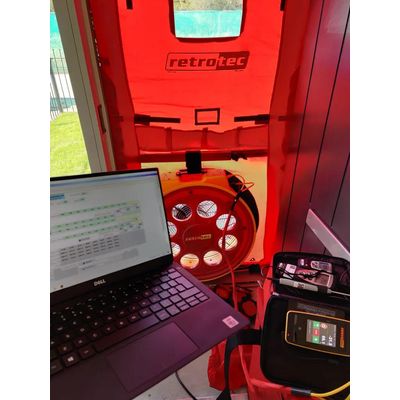
Typically a test is carried out by a single engineer using a UKAS calibrated blower door system. The system is essentially a fan mounted within a canvas, that’s installed within an external door or window. The fan is controlled by a fan speed controller, and a number of tubes connected to a multi-channel manometer, which is read and inputted into a software to generate a result.
Generally during this time other trades can remain within the building so long as the external envelope remains closed (external doors and windows) and internal doors open.
Typically the test takes between twenty minutes to a couple of hours. However, this all depends of the size of the building, the test locations, the ability to create stable pressure in the building and unfortunately the controllable influence of the British weather.
In Approved Document Part L1 of the Building Regulations, the process of assessing a building’s air tightness is commonly referred to as Pressure Testing. This methodology, as defined in ATTMA Technical Standard 1, is based on internationally recognised standards like BS EN Standard ISO 9972:2015. Likewise there may be a need to test to the revised CIBSE TM23.
For new dwellings, as stipulated in Approved Document L1, airtightness tests are mandatory for all new build dwelling. Compliance with Part L1 necessitates that any tested dwelling achieves an air pressure test result (known as a design air permeability) of 8m³/h/m² or less at a pressure differential of 50 pascals for Building Control.
As expected, the equipment used for Air Permeability Testing is highly specialised and demands frequent and rigorous calibration to ensure precision. As a result, equipment from Building Compliance Testing is calibrated by a UKAS approved laboratory to guarantee accuracy during on-site tests. Our sister company, Building Compliance Testing is registered with ATTMA, subject to regular audits to uphold high standards and accuracy. If you’re uncertain about whether your project necessitates an Air Testing, we can provide guidance. We also offer complimentary, no-obligation quotes at highly competitive rates for projects of all sizes.
Air testing assesses energy performance by measuring air volume escaping per hour per square meter at 50 Pascals. It identifies gaps and cracks in building envelopes, reducing heating or cooling costs. Using a blower door system, the test takes 20 minutes to a few hours. Building Compliance Testing offers design reviews, site inspections, and training for compliance. Additionally, it provides services like smoke testing and Passivhaus testing.