


- Home
- Companies
- MedPro Disposal, LLC
- Services
- MedPro - Biohazard Waste Disposal ...
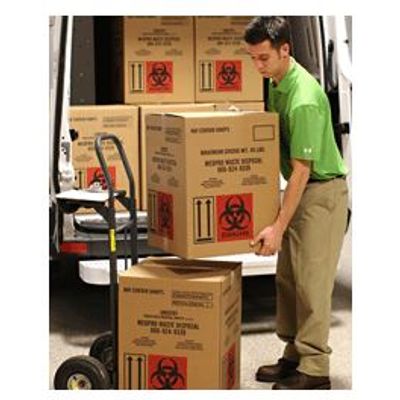
MedPro - Biohazard Waste Disposal Service
Biohazard waste is generally defined asany waste contaminated with potentially infectious agents or materialsthat may pose a threat to public health or the environment. Biohazardous waste includes:
- Medical waste
- Sharps
- Other Biohazardous Substances
Categories of Biohazard Waste
There are four categories of waste. Each form is separated, identified, sterilized and recycled appropriately to minimize exposure and risk to the environment and general population.
- Solid waste includes non-sharp items contaminated with any bodily fluids or biological material. For example, gloves, pipettes, towels, or culture.
- Liquid waste includes bulk quantities of blood or bodily fluids.
- Sharps waste includes any materials that can puncture or pierce through skin and is contaminated with biological material that can risk transmission or release to the environment. For example, needles, syringes, scalpels, microscopic slides, small broken glass or tubes.
- Pathological waste includes human organs, tissues and body parts with the exception of teeth.
It is important for healthcare facilities to take caution while handling biohazardous material and that only trained personnel handle and transcript this type of waste for disposal. For additional information, please refer to MedPro’s resources or ask about our OSHA Compliance Training services.
Biohazard waste is waste that is contaminated with blood or other infectious materials. The infectious materials pose a risk of spreading disease in humans, animals and the environment. Biohazard waste is typically treated in an autoclave process which renders the waste harmless and then it is disposed of. Medical waste can be very confusing, what federal laws apply? What are my local State, City. County requirements? We have put together this handy guide and hope you find it useful.
Do you know how to identify biohazard waste?
Do you know how to properly package this type of waste?
We at MedPro Disposal have put together a useful guide on everything you should know about biohazard waste disposal. From identifying what biohazard waste is to the management, collection, and treatment of it. MedPro Disposal provides all the important facts and answers to your questions.
How to Identify Biohazard Waste
Biohazard waste is short for biohazardous waste and is also known as biomedical waste. Biohazard waste is any biological waste that is potentially infectious. The Hazard Awareness and Management Manual (HAMM) of Environment Health & Safety (EHS) outlines the types of biohazard waste as follows:
Human blood and its components
This may be in liquid or semi-liquid form, dried or not.
Human bodily fluids
This may include semen, vaginal secretions, cerebral spinal fluid, synovial fluid, pleural fluid, pericardial fluid, peritoneal fluid, amniotic fluid, and saliva. It may be in liquid or semi-liquid form, dried or not
- human pathological waste: all human tissues, organs, and body parts
- animal waste: all animal carcasses and body parts
- microbiological waste: laboratory waste containing infectious agents (including discarded specimen cultures, stocks of etiologic agents, discarded live and attenuated viruses, wastes from the production of biologicals and serums, disposable culture dishes, and devices used to transfer, inoculate and mix cultures)
- sharps waste: sharp medical utensils such as scalpels, needles, glass slides, lancets, glass pipettes, broken glass that have been contaminated with potentially infectious material
Further to this list, any medical supplies or other equipment (such as gloves, towels, used bandages and dressings, tubes) that have come into contact with the above mentioned materials and consequently exhibit more than trace elements of these biological materials in them are themselves also classified as biohazard waste.
Biomedical Waste
According to the World Health Organization, of all waste generated by healthcare activities, 85% is general, non-hazardous waste but the remaining 15% is hazardous and may be infectious, toxic, or radioactive. Biomedical waste is generated by:
- healthcare facilities (hospitals, clinics, nursing homes, physician offices, dentist offices, home health care facilities)
- medical research laboratories / centers (including animal research & testing laboratories and schools & universities)
- mortuary & autopsy centers and funeral homes
- blood banks and collection services
- jails and prisons
- casinos
- veterinarian offices, animal shelters, and animal hospitals
Biohazard waste can also be present at the scene of a violent crime, industrial accident, trauma, or suicide. [i] [ii]
Biohazard Waste Disposal
The lifecycle of the management of biohazard waste is as follows: generation, accumulation, handling, storage, treatment, transport, and disposal. [iii] In the United States, biohazard waste management is regulated by the Environmental Protection Agency (EPA) and the Occupational Safety and Health Administration (OSHA), via Title 40 and Title 29, Subpart H – Hazardous Materials of the Code of Federal Regulations (CFR), respectively. Additionally, the Center for Disease Control (CDC) also provides guidelines for the management of biohazard waste. Finally, each state, university, center, company, facility, or organization has its own standards and practices. Discussed in this blog will be the recommendations, guidelines, and standards of the WHO and the United Nations (UN).
Packaging, Classification, and Storage of Biohazard Waste
The first step in handling biohazard waste is to segregate the various types and place them into suitable containers. This can be done as follows:
- Non-hazardous material or general healthcare waste should be separated from the biohazard waste and can be discarded with the rest of the non-hazardous material.
- If non-hazardous waste is mixed with hazardous waste, then the entire mixture should be considered hazardous and dealt with accordingly.
- Sharps must be placed in puncture-proof, tamper-proof container. Typically, the container is made of metal or a high-density plastic but dense cardboard with plastic lining can also work. Sharps containers must not be overfilled so the general rule is that once these containers are three quarters (3/4) full, they should be removed.
- Infectious waste is placed in leak-proof plastic bags / containers that are suitable for the type of material and that bear the international infectious substance symbol:
Collection and Transportation
Biohazard waste should never be allowed to accumulate by the producer of the waste without a well-established plan for routine collection. Waste should be collected as frequently as possible. No containers should be picked up unless they are properly and completely labelled. The staff of the facility / organization that generated the biohazard waste should promptly replace containers so their own staff always follow safe practices when dumping the waste. And in addition to proper labelling, all arrangements and preparation for safe and steady transport should be made well in advance – dispatch documents, shortest route, fewest handling changes, reliable carrier, and in the case of exportation / importation, all required legal documents, international standards, and local regulations.
The carrier transporting the biohazard waste should be registered with the waste regulation authority, and the biohazard waste disposal company should also hold a permit for their work. The waste should be accompanied by a consignment note from the point of generation to the place of disposal.
Biohazard waste transport vehicles should be closed and locked. They should be designed to minimize the damage to the container holding the bags / containers of biomedical waste. Empty bags and containers suitable for waste being transported, suitable protective clothing for staff, cleaning equipment, and special kits for dealing with spills / leaks should be available in the vehicle compartments. The carrier organization’s name should be clearly visible on the transport vehicles. The international symbol for biohazardous material and / or radioactive material should be displayed on the vehicle along with an emergency telephone number. And if the transportation of the biomedical waste exceeds recommended storage duration limits, a refrigerated container must be used. [iv]
Treatment and Disposal
Treatment of biomedical waste is used to reduce or eliminate its hazard to people and the environment. The treatment is performed by biohazard waste disposal companies registered with the regulating authorities of the locale so this is why this process usually doesn’t take place until the very end of the biohazard waste management process. If the treatment and or disposal is not conducted professionally, efficiently, and using modern technology, it can have highly adverse effects on the environment, causing more harm than good. Upon treatment, waste can be transported to a landfill. Treatment is provided to facilitate biohazard waste disposal.
A common method of treatment is called incineration. Incineration is the application of high temperatures to biohazard waste to kill all organic substances (bacteria, viruses, and other pathogens) contained in the waste. Typically, the waste is converted into ash and gas that often needs to be further cleansed before it can be released into the environment. Upon the completion of the process, the biomedical waste is no longer hazardous. This type of treatment is usually conducted in an incineration plant that may even generate electric power from the heat of the incineration.
“Incineration of waste has been widely practiced, but inadequate incineration or the incineration of unsuitable materials results in the release of pollutants into the air and of ash residue. Incinerated materials containing chlorine can generate dioxins and furans, which are human carcinogens and have been associated with a range of adverse health effects. Incineration of heavy metals or materials with high metal content (in particular lead, mercury and cadmium) can lead to the spread of toxic metals in the environment. Only modern incinerators operating at 850-1100 °C and fitted with special gas-cleaning equipment are able to comply with the international emission standards for dioxins and furans.” ii
Another treatment method that can facilitate the biohazard waste disposal process is autoclaving. An autoclave is a strong, highly-pressurized, steam-heated chamber used to sterilize biomedical waste. Autoclaves are also routinely used to sterilize medical supplies. Items such as plastics can be sterilized by autoclaving and completely melted down to ensure they are virtually pathogen-free; they can then be used to make new products.
Yet another method for disinfecting biohazard waste is the use of bleach. Bleaching refers to a process by which certain types of chemicals (often some compound including chlorine) initiate a chemical reaction with the chemicals of the biomedical waste that makes them gain or lose electrons, resulting in a chemical change in the waste, making it non-hazardous.
And finally, alkaline hydrolysis (biocremation and / or resomation) is a funeral home service provided as an alternative to burial or cremation, reducing carbon dioxide and pollutant emissions from the traditional processes.