

- Home
- Companies
- Infraspect
- Services
- Cable Stayed Bridge Inspection Service
Cable Stayed Bridge Inspection Service
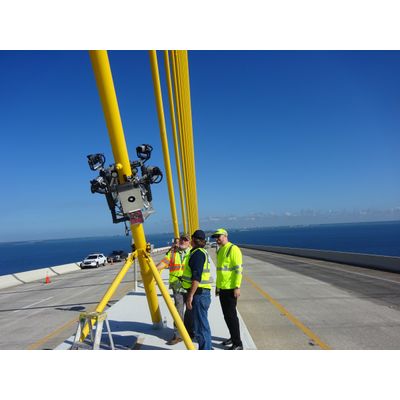
Visual for NBI Inspections and Magnetic Flux Leakage (MFL) To Peer Through the High-Density Polyethylene (HDPE) Cable and Locate Inside the Steel HDPE Sheathing. CableScan® is a patented robotic cable-stay inspection service that consists of two inspection services. The first utilizes high-definition video technology. CableScan® visual does not require lane closures, man-lifts, bucket trucks, or night-time inspections. It is a self-propelled robotic system controlled by a base station that receives HD video and MFL transmissions from the robotic crawler. By utilizing Infraspect’s robotic CableScan® any imperfections along the cable stay are recorded as well as the length traveled along with the stay, and the corresponding length traveled along the deck. We can provide the length and size of cracks and other abnormalities on the cable stay. The internal technology in CableScan® utilizes MFL to locate section loss and corrosion through the HDPE sheathing on the exterior strands of steel inside of the steel cables.
CableScan® inspections take into account all of the required parameters of Federal Highways (FHWA) for bridge cable inspections. The location of any abnormalities along the cable stay are recorded so follow up maintenance and reviews can be performed. In addition the the location on the cable as well as the location on the ground are recorded so that maintenance crews can park their truck directly under the affected area. This makes is easier to instantly access the correct location for repair work.
By maintaining a historical record of the inspection, any inconsistencies however slight can be reviewed over multiple inspection cycles to quickly determine if there has been any increase in deterioration so that further repair action can be taken if needed.
- No lane closures
- Saves money (inspection)
- Saves money (repairing in a timely fashion will extend the service life)
- Safer for the inspectors
- Less subjective than current methods
- Safer for the public (no boom trucks parked on the bridge at night)
- Deterioration progression can be properly monitored