


- Home
- Companies
- OGI Groundwater Specialists Ltd
- Services
- Computer Modelling Services
Computer Modelling Services
OGI uses computer modelling packages to analyse and simulate many different conditions associated with the ground. OGI has developed in-house computer models to simulate the behaviour of groundwater, heat and dissolved contaminants within the ground. This results in the ability to simulate and predict changes in water and soil pressures, dissolved contamination flowing within groundwater, and the ground temperatures and available heat resource.
OGI has developed many software programs in-house, giving OGI unique capabilities for computer modelling. The outputs from some of our computer packages are used as inputs for commercially available software.
GEMOS (OGI software)
Analytical solution for the analysis of steady state groundwater flow.
Themos (OGI software)
Analytical solution for the analysis of steady state heat flow.
CVM. Curved Valley Model. (OGI software)
Finite Element model for the analysis of transient groundwater flow and contaminant transport. Provides solution to 1D Cartesian and radial groundwater flow equation.
ThermRoute (OGI software)
Finite element model for the analysis of transient and steady state heat flow. Provides solution to heat generated by a borehole field.
SEFTRANS. Simple and efficient flow and transport model. (OGI software)
Finite element model that provides simple analysis of 2D fluid flow and contaminant transport problems.
SURFER, for 3D contours and surfaces modelling
Surfer is a full-function 3D visualization, contouring and surface modelling package that runs under Microsoft Windows.
Surfer is used extensively by OGI for terrain modelling, landscape visualization, surface analysis, contour mapping, and 3D surface mapping.
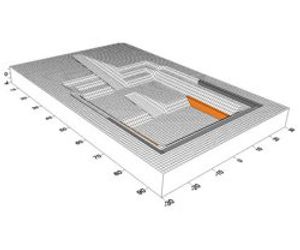
MODFLOW, for simulating the flow of groundwater through aquifers
- MODFLOW-2005 simulates steady and non-steady flow in an irregularly shaped flow system in which aquifer layers can be confined, unconfined, or a combination of confined and unconfined.
- Flow from external stresses, such as flow to wells, aerial recharge, evapotranspiration, flow to drains, and flow through river beds, can be simulated. Hydraulic conductivities or transmissivities for any layer may differ spatially and be anisotropic (restricted to having the principal directions aligned with the grid axes), and the storage coefficient may be heterogeneous.
- Specified head and specified flux boundaries can be simulated as can a head dependent flux across the model’s outer boundary that allows water to be supplied to a boundary block in the modelled area at a rate proportional to the current head difference between a “source” of water outside the modelled area and the boundary block.
SIGMA/W, for stress-deformation
SIGMA/W is a finite element CAD software product that can be used to perform stress and deformation analyses of earth structures.
SIGMA/W can perform a simple linear elastic deformation analysis or a highly sophisticated, nonlinear elastic-plastic effective stress analysis.
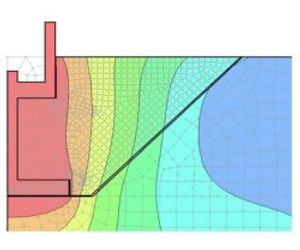
SLOPE/W, for slope stability
SLOPE/W is the leading slope stability CAD software product for computing the factor of safety of earth and rock slopes.
SLOPE/W can model heterogeneous soil types, complex stratigraphic and slip surface geometry, and variable pore-water pressure conditions using a large selection of soil models.
Stresses computed by a finite element stress analysis may be used in addition to the limit equilibrium computations, for the most complete slope stability analysis available.
SEEP/W, for groundwater seepage
SEEP/W is a finite element CAD software product for analysing groundwater seepage and excess pore-water pressure dissipation problems within porous materials such as soil and rock.
SEEP/W can model both saturated and unsaturated flow, a feature that greatly broadens the range of problems that can be analysed. In addition to traditional steady-state saturated flow analysis, the saturated/unsaturated formulation of SEEP/W makes it possible to analyse seepage as a function of time and to consider such processes as the infiltration of precipitation.
The transient feature allows you to analyse such problems as the migration of a wetting front and the dissipation of excess pore-water pressure.