

- Home
- Companies
- Digested Organics LLC
- Services
- Digested - In-House Pilot Testing ...
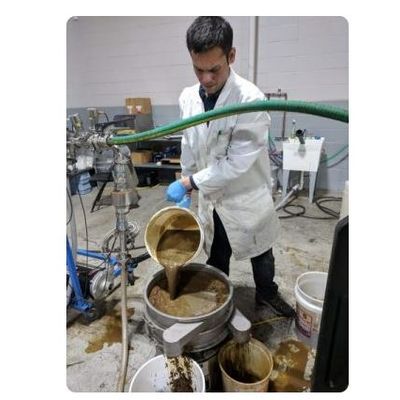
Digested - In-House Pilot Testing Services
At our headquarters in Farmington Hills, Michigan, we have a complete pilot testing facility and wet chemistry laboratory to help solve your toughest liquid separation challenges. We can work with samples as small as 5 gallons to as large as a 1,000 gallons to determine how our screening, microfiltration, ultrafiltration, forward osmosis, and reverse osmosis solutions can be used to achieve your goals. Our pilot facility is directed by Dr. Sam Bagchi, with support from technicians and scientists who are passionate about developing customized solutions for your applications. We pride ourselves on thinking outside the box to meet your goals with a cost effective, space efficient, and highly reliable solution.
- Vibratory screen (various screens 80-1000 micron available)
- Spiral Brush Filter (15, 25, 50, and 100 micron screens)
- Stainless Steel Microfiltration (0.1 micron average pore size)
- Stainless Steel Ultrafiltration (0.02 micron average pore size)
- Forward Osmosis
- Reverse Osmosis
- Total solids
- Total suspended solids
- Total dissolved solids
- pH
- Electrical conductivity
- Total nitrogen
- Ammonia nitrogen
- Total phosphorus
- Chemical Oxygen Demand
Additional testing is commonly performed on samples by third party laboratories. We commonly test raw samples, permeate, and concentrate for: Total Solids, Total Kjeldahl Nitrogen (TKN), Ammonia-Nitrogen (NH4-N), Organic Nitrogen (Org-N), Phosphorus, Potassium, Sulfur, Calcium, Magnesium, Sodium, Iron, Manganese, Zinc, Copper, pH and Conductivity
Typical Pilot Testing ExperienceWe make in-house pilot testing simple and easy! Here’s how it works:
- A customer ships in 20 to 40 gallons of material, usually in carboys, Cubitainers, or 5-gallon buckets. Please contact us for recommendations on shipping procedures.
- We run the sample immediately upon receipt. We collect a sample of the raw material and the filtration products for analysis in our lab and external labs.
- We collect operational data from the pilot equipment, such as flow rates, temperatures, pressures, membrane flux rates, and more to determine a preliminary design for commercial scale equipment.
- We perform any necessary cleaning of our screening or membrane equipment to identify if your liquid presents any unique challenges for standard Clean-in-Place protocols.
- We summarize all our findings in a pilot report, which typically accompanies a budgetary proposal.