

- Home
- Companies
- DeepEarth Technologies, Inc.
- Services
- Cool-Ox Site Remediation - ...
Cool-Ox Site Remediation - Environmental Remediation and Cleanup
DeepEarth Technologies, Inc. (DTI) is an environmental restoration company specializing in providing Cool-Ox® technology for cleaning up contaminated soils and groundwater. Cool-Ox® has been awarded fourteen (14) patents in the US, Canada, Europe and Australia. The Cool-Ox® process is designed to eliminate a wide variety of contaminants including petroleum hydrocarbons, chlorinated organics (PCP, PCB, DDT, Dioxins), nitrate explosives (TNT, DNT) and brine. It is especially effective at destroying vapor phase contaminants (HC-VOC, CVOC) impacting various types of soils including clay (ChemHydro-Infusion™). While Cool-Ox® is tough on contaminants, it is gentle on vegetation. Because the mechanisms are different, Cool-Ox® can eliminate pollutants while actually promoting plant growth.
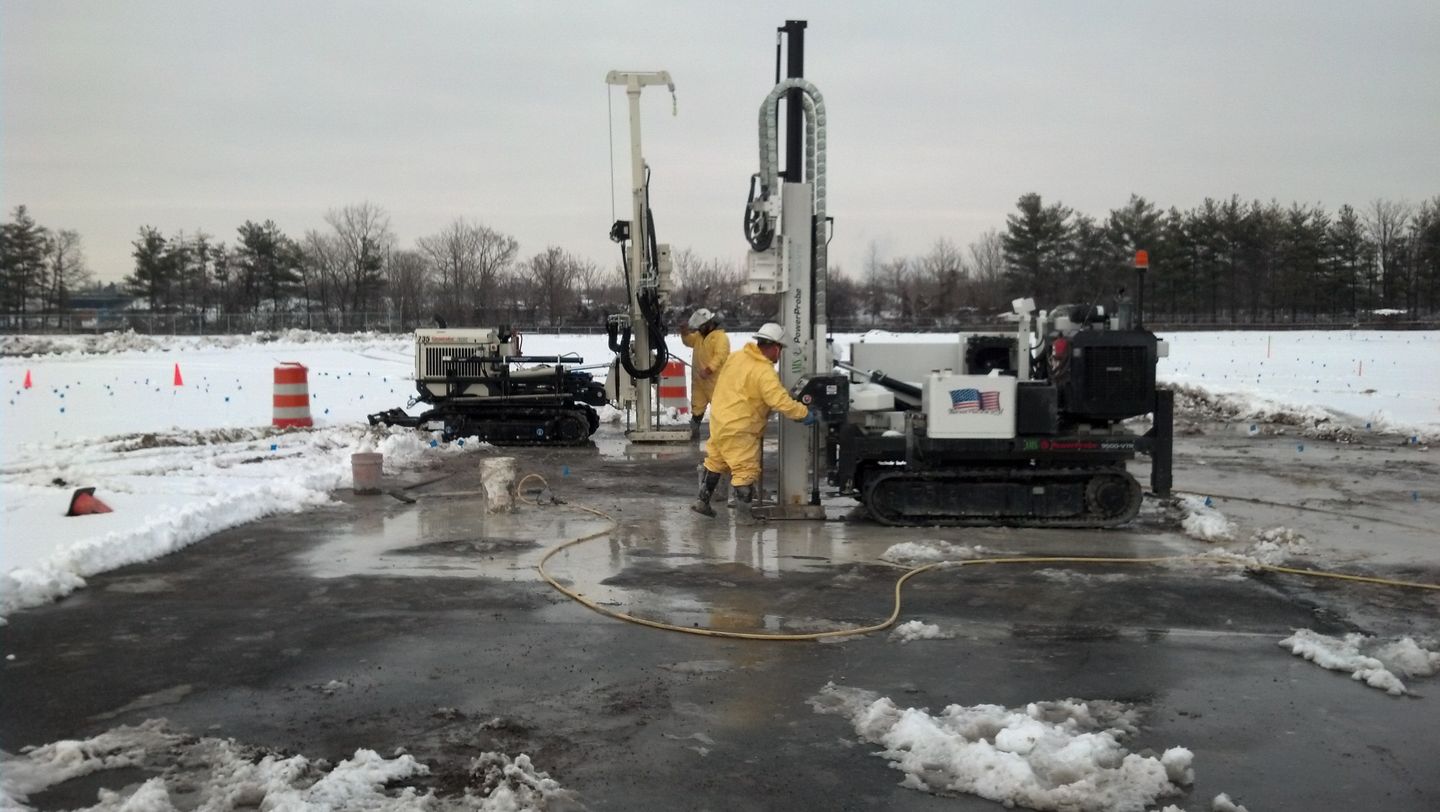
The Direct Push Technology (DPT) application process of the Cool-Ox® Technology is our most highly demanded application. We use our AMS Power Probe 9500VTR rig to drive 1 ½ inch hollow core steel rods to the desired depth (generally just below contaminate level) and begin injection. Cool-Ox® is injected throughout the contaminated zone at pre-determined depth intervals from the bottom up or from top down. This process allows us to completely saturate the contaminated soil with the reagent in a cost effective and efficient application process at depths greater than ten to fifteen feet. DPT is ideal for work on sites where the soils consist of clay, sand, and silty sand. DPT can also be implemented in soils containing cobbles. DeepEarth Technologies, Inc. has completed projects using the DPT application on sites that contain concentrations of limestone as well.
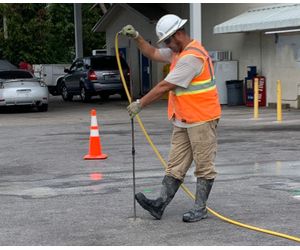
DTI’s Hydro-Dart™ is a hand held injection tool which uses high velocity fluid to cut the soil, allowing it to be inserted by hand. It is especially useful where sandy or clay soils are encountered. It is not generally well suited where gravelly or aggregate fill materials where cobbles or crushed rock are incorporated. This application method allows DTI to treat soils from a depth of zero (0) to a depth of twelve (12) feet with minimal disruption to surface vegetation. A maximum depth of (twelve) 12 feet is preferred however, applications to fourteen (14) feet have been completed with the aid of an additional technician. Since no machinery is required at the injection point, little to no disruption of surface vegetation is apparent.
The Hydro-Dart™ lance is a 5/8-inch steel rod. DTI’s field crew pumps Cool-Ox® under pressure and advances it into the subsurface. The pressure varies from site to site depending on the lithology. Pressures between 150-500 psi can be expected.
When we reach the desired depth, the pressure is lowered (by decreasing the pump rate) to keep the annulus of the rod sealed. If debris is encountered, such as cobbles, wood, cement pieces, or any material we cannot push through, the DPT rig is implemented. If the lithology doesn’t allow the annulus to seal, then again, the DPT rig is implemented to seal the rod and insure the distribution of the Cool-Ox® reagent into the subsurface.
The Hydro-Dart™ has also proven to be a very useful tool for injecting under building slabs or inside basements by sampling drilling access ports through the concrete floors. If any daylighting of the reagent occurs, it is immediately captured employing a shop or drum vacuums. This material can be contained for legal disposal. When the work is completed, the injection ports are sealed with bentonite and the appropriate paving material.
The Cool-Ox® Hydro-Dart™ application process is a highly efficient, non-invasive technique for treating shallow sub-surface contaminants. The Hydro-Dart™ application process used with the Cool-Ox® technology is an extension of DTI’s Direct Push Injection Technology. This application process may also be the most cost-effective application method for certain sites, depending on the depth of the contaminant and if underground piping or utilities are in the treatment zone.
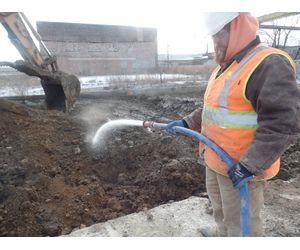
Soil Blending
Excavation Problems Eliminated by the Application of the Cool-Ox® Soil Blending Process
- the need to excavate
- the need for sheet piling and/or shoring
- the need to dewater
- the complications of POTW disposal restrictions
- the need to treat groundwater
- the requirement for a NPDES permit
- the need for contaminated soil treatment/disposal
- transferred liability (huge issue with lawyers)
- EPA permitting requirements for excavated contaminants
- the need to classify and permit waste to disposal facility
- risk of waste rejection from disposal facility
- ingress/egress trucking issues
- the need for backfill material
- the generation of odors or noxious gasses
- hazards of open excavations
- hauling permitting problems
- potential odors from transported waste
- many safety hazards of concern to Loss Prevention Programs
- waiting for trucks
- Non-uniform incorporation of reagent
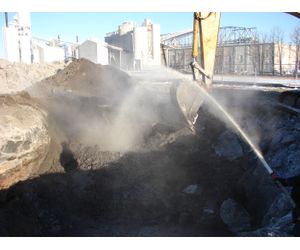
DTI has developed a process, based upon the Cool-Ox® chemistry, to treat excavations for odor control where large quantities of pollutants are uncovered during the excavation work. This technology has been used to treat several sites and is known to the industry as the Pit-Stop™ Process.
The purpose of the Pit-Stop™ Process is two-fold. The first is to remediate contaminants found during excavation activities and secondly, to eliminate odors caused by the presence of such contaminants.
An explanation of the remedial oxidation mechanism can be found by consulting the Cool-Ox® technology section. Odor control proceeds by an extended mechanism of this process.
A characteristic of the Cool-Ox® Technology is the production of a lather (resembling dirty shaving cream), when the reagent reacts with organic contaminants. This reaction proceeds when any organic compound reacts with hydrogen peroxide derived oxidizers in an in-situ environment but, is useful only when the reaction can be controlled. Hydroxylation of organic molecules produce oxygenated carbonaceous products. Because these compounds contain both a hydrophobic and hydrophilic component, they are by nature, wetting agents or in the broad sense of the term; surfactants. As such, they produce a foam when agitated. This foam insulates the contaminant (the source of odors) from the air (the transport mechanism) in the excavation thus inhibiting the distribution of the volatile odor compounds.
While this chemo-mechanical system works well to suppress odors, the subtlety of the process is the conversion of the odorous molecules themselves to surfactants. This not only reduces their concentrations but, converts them to more water soluble compounds (surfactants) that in fact, trap them in the reagent rich reaction matrix. Thus, as the reaction proceeds, the volatile compounds responsible for causing odorous conditions are themselves converted to the suppressants that obviate the problem.
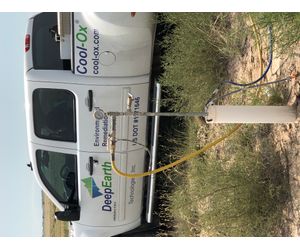
DeepEarth Technologies, Inc. (DTI) utilizes many different application methods. One of these application methods is the use of packers to inject Cool-Ox® into onsite wells. DTI can inject into 2” and 4” wells utilizing Packers (see images below).
DTI places the packer at the top of the well casing and inflates it using an air compressor until a snug fit is achieved. Once this is achieved, the shut off valve is closed, and the air line to the compressor is disconnected. Once the packer is in place, DTI connects the injection hose and begins the injection process. The use of packers for this type of application ensures that the Cool-Ox® reagent is injected under pressure (± 100 PSI) in order to push the reagent out of the screened interval and into the groundwater zone. Both the air line and injection line are fitted with appropriate pressure gages and shut off valves in order to minimize chance of failure.
Although this is not the preferred application method, well injections have been used by DTI many times when other methods alone are either not an option or not enough to reach our client’s goals. During the application design phase of any project where well injections become feasible, well (MW, RW, IW) construction logs and any other installation data/diagrams will be requested by DTI to determine integrity and injectability of the onsite well/s.