


- Home
- Companies
- MEMBRAFLOW control systems GmbH
- Services
- Filtration-Membrane-Technology Services
Filtration-Membrane-Technology Services
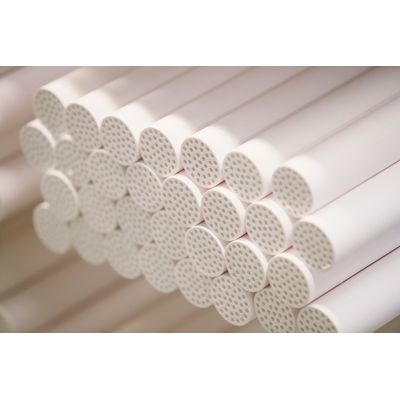
Membrane technology is a mechanical separation process utilized to separate gaseous or liquid mixtures and solutions using specialized membranes. Depending on the membrane type, it caters to various separation requirements, offering both economic and ecological benefits through physical separation. The core structure of a membrane involves a support body with a microporous surface, topped by the membrane layer that dictates filtration fineness. In a closed-loop system, the impure mixture flows over the membrane layer, which filters particles larger than its pores, allowing the purified medium to pass through. Different geometries exist for different needs, with elements available as mono or multi-channel with varying diameters, providing up to 211 channels per element in some cases. Membrane processes are classified into microfiltration, ultrafiltration, nanofiltration, and reverse osmosis based on particle size. Various polymeric plastics and ceramics are used as membrane materials, with ceramics often preferred for their longevity and superior mechanical and chemical properties, achieving separation limits from 1 to 1400 nanometers. Applications span environmental technology, water technology, the food and dairy industries, and bio and fine-organic chemistry. Key benefits include definable process separation limits, durable and inert membrane materials, potential chemical-free operation, low operating costs, modular and expandable construction, compact systems with minimal filling volumes, high automation levels, and scalable system capacities, ensuring rapid amortization. For unknown filtration properties, testing is available via laboratory or pilot scale units, aiding in the design of industrial filtration plants.The membrane technology is a mechanical separation process for the separation of gaseous or liquid mixtures and solutions using technical membranes. Depending on the type of membranes used separation results for a variety of requirements can be achieved. In terms of economic and ecological aspects, this type of filtration is of particular importance due to the purely physical separation of mixtures or solutions.
The basic structure of a membrane comprises the support body with microporous structure, on which a membrane layer is applied. This membrane layer determines the filtration characteristics by their fineness.
The liquid mixture to be purified flows along the membrane layer in a closed loop system. Thereby, the membrane layer keeps particles larger than the separation layer back and the clarified medium permeates the membrane layer and is separated.
Depending on the requirements, different membrane geometries are used. At first, the membrane elements are differentiated in mono and multi-channel elements. The channel diameters in the mono-channels that are most likely be installed in pilot plants, are typically between 6 and 16 millimeters. In multi-channel elements, several channels are arranged side by side in the same membrane element, having channel diameters in the range of 2 to 8 millimeters. Depending on the outer diameter of the ceramic element, this results in up to 211 channels in each single membrane element.
Environmental technology
- Waste water treatment
- Clarification of metallic components (e.g. Ni, Mn, Co, Al)
- COD / BOD reduction
- Process water treatment
- Removal of dissolved dyes and insoluble pigments
- Treatment of wiping solution at the intaglio printing process
- > patented process – technology
Water technology
- Drinking water treatment
- Softening
- De-mineralization
- Removal of pesticides and other organic acids
- Removal of metallic impurities (e.g. Fe, Mn, As)
- Removal of natural organic substances
Food industry
- Clarification of products such as wine, fruit juices and gelatin
- Concentration of dissolved recyclables such as pectin or sugar
- Treatment of CIP-solutions for service life extension
- Degassing of liquids such as dissolved oxygen
- Clarification of glucose syrup
- Treatment of vapor condensate – removal of carbohydrates
- Clarification of molasses
- Recovery of proteins from CSL / wash water
Dairy industry
- Recovery of proteins, lactose and minerals from cheese whey • Concentration of full and lean milk
- Protein standardization of milk
- Desalination of whey proteins
- Clarification of salt brine (service life extension) • Concentration of butterfat
-
Modular construction with expandable capacities
-
Compact systems with low total filling volumes
-
Possible high degrees of automation
-
All system capacities possible – no technical limitations
-
Amortization within shortest time periods