


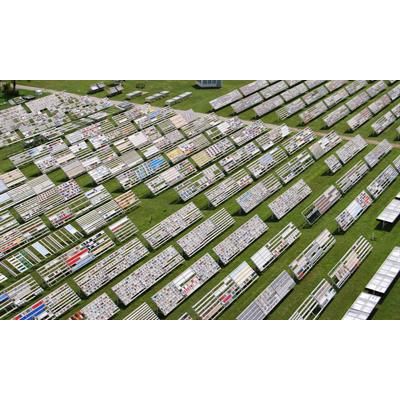
Florida & Arizona Outdoor Exposure Testing
Q-Lab offers outdoor exposure testing programs at our internationally recognized benchmark locations in Florida and Arizona. Weathering exposures at these sites are not only realistic, they are also accelerated. The subtropical, sunny, humid and warm conditions in Florida make it the ideal climate for testing the durability of materials in outdoor environments. Arizona's high levels of UV and very hot temperatures make it the perfect location for testing exceptionally durable materials. Test services at both locations use a variety of specimen mounting and exposure techniques to meet a wide array of weathering and corrosion test methods.Why Florida?
Florida is the internationally recognized benchmark location for outdoor exposure testing. Florida subtropical weathering exposures are not only realistic, they are also accelerated. One year of Florida sunshine can equate to several years of weathering elsewhere. Our Florida site has high-intensity sunlight, high annual UV, high year round temperatures, abundant rainfall and very high humidity.

It is this synergistic effect of UV, moisture and heat that makes Miami the ideal location for testing durability of materials in outdoor environments.
The extremely sunny, humid, and warm climate has been proven especially useful for certain types of testing including:
- Color change, fading, and gloss loss
- Cracking, peeling, chalking, and blistering
- Mechanical strength loss and physical deterioration
- Moisture sensitivity of products like coatings, building materials, and some plastics
- Biodegradation, including mold, mildew, fungus and algae
- Accelerated corrosion testing
A Variety of Different Exposure Techniques
Various specimen mounting and exposure techniques are available for natural outdoor exposure testing in Florida:
- Direct Exposure:Direct exposures are used to test many exterior-use materials, such as industrial coatings. Specimens are securely mounted with their front surface facing the sun. Different exposure angles and mounting methods are used for different applications.
- Under Glass:These exposures are used to test interior-use materials, such as textiles and printing inks. Specimens are behind 3 mm window glass which will filter out short-wave UV. Exposures are typically at 45º.
- Black Box:These tests reproduce conditions found on the horizontal surfaces of a vehicle, including higher temperatures and wet times. Under glass black box exposures are used to test interior automotive materials.
- AIM Box (Automotive Interior Materials):These under glass exposures simulate the environment inside an automobile and are suitable for mounting larger components like dashboards. Some AIM boxes feature solar tracking.
- Salt-Accelerated Outdoor Corrosion: Direct exposures with salt spray can produce fast and realistic corrosion, particularly for coated metals.
- Mildew Tests: In this Florida exposure, panels are typically positioned at a 90º north to reduce sunlight, decrease surface temperatures, and increase moisture. In addition, specimens may be placed near or under vegetation to promote growth.
The specific type of specimen mounting technique and exposure angle both have a significant effect on solar energy dosage, specimen temperature, and time of wetness. For a full description, see LL-9025 - Outdoor Weathering Exposure Procedures, or contact Q-Lab to discuss which option is suitable for your test program.
Florida Weathering & Corrosion Test Methods
Florida outdoor exposure testing meets a variety of weathering and corrosion test methods, a small portion of which are listed below. Visit our Standards Page or contact Q-Lab for a more complete list.
- Direct & Under Glass Exposures (ASTM G7, G24, D1435)
- Black Box (ASTM D4141; GM 9163P)
- AIM Box (GM 9538P, 7455M, 7454M, 3619M; GMW 3417)
- Natural Atmospheric Corrosion (ASTM G50)
- Salt Accelerated Corrosion - SCAB (ASTM D6675)
Natural exposure testing is an essential part of any weathering and light stability test program. Even if you perform accelerated laboratory weathering testing, you should also perform natural outdoor testing. Furthermore, many companies test their products outdoors in both Florida and Arizona.