


LUMI-CELL - For Estrogen Receptor - α (ERα)
What is LUMI-CELL? Similar to the CALUX bioassay, LUMI-CELL is a screening assay using a recombinant cell line (Human breast Carcinoma cell “VM7Luc4E2”) containing a stably integrated ER-responsive luciferase reporter gene for detection and relative quantitation of estrogenic or antiestrogenic activity of chemicals or extracts. The LUMI-CELL bioassay was endocrine disruptor compounds developed by Dr. Michael S. Denison, UC Davis.
Traditional instrumental analysis methods can provide outstanding high-resolution quantitative results for the known estrogenic chemicals that are being measured. However, the major limitations of instrumental analysis methods for estrogenic chemical screening and monitoring purposes is that they are not able detect unknown estrogenic chemicals and they can’t provide a measure of the total estrogenic activity of a sample extract. In contrast, ER-based cell bioassays provide an avenue in which to detect all estrogenic chemicals in a sample extract (known and unknown) and determine its total estrogenic activity. These aspects, combined with the fact that cell bioassays are also significantly less time-consuming and costly as instrumental analysis make them the preferred method of choice for open screening and monitoring purposes.
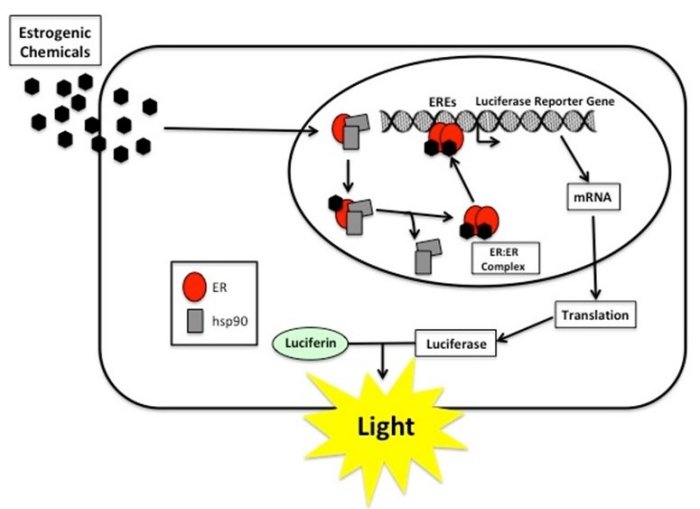
The LUMI-CELL® bioassay has been shown to be and effective method for measuring the estrogenic activity of many matrices, including: food, feed stuffs, biologicals, sediments, air, water, pharmaceuticals, cosmetics, pesticides, steroid products and many more. This bioassay is also able to detect total estrogenic or antiestrogenic activity for a sample, with detection limits of ~0.04pg/g.
This figure shows the results of analysis of the estrogenic activity of selected chemicals. While the estrogenic potency and efficacy of the synthetic estrogen, Diethylstilbestrol (DES), was similar to that of 17β-estradiol (E2), numerous phyoestrogens (Genistein (from soy), Daidzein, and Zearalenone (mycotoxin)) and other compounds showed reduced potency but were efficacious ER activators. These results demonstrate the utility of the LUMI-CELL® bioassays for detection and relative quantitation of estrogenic chemicals.