


- Home
- Companies
- G Stow PLC
- Services
- G-Stow - Drilling Boreholes Management ...
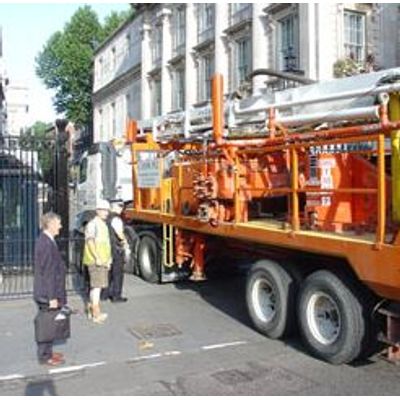
G-Stow - Drilling Boreholes Management Service
We offer a total management service for your whole project, including:
- Feasibility
- Technical appraisal and design
- Costing
- Health & Safety management
- Environmental management
- Drilling
- Test pumping
- Treatment
- Distribution
- Licence application
- Principal Contractor scheme members
- CSCS accredited site staff
We use a wide range of drilling methods for all varying geological conditions:
- Reverse circulation rotary
- Direct flush rotary using mud, air, water, & foam
- Cable tool percussion
- Down the hole hammer rotary
- Chilled shot rotary
- Rotary auger, continuous flight and bucket
- Tube vibrator
- Underreaming
- Coring
Projects regularly undertaken include:
Water supply boreholes, Geothermal boreholes, Lift shafts, Piles, Access shafts, Dewatering holes, Cooling water boreholes and Irrigation boreholes.
There are many different types of water bearing strata, requiring variations in construction methods and materials – from complicated sand aquifers where specially graded gravel packs and borehole screens retain formation sand but permit groundwater to enter the borehole – to more basic open hole completions. With our extensive global experience G Stow plc can offer solutions and designs for every type of aquifer.
By undertaking desk top studies and researching our substantial archives, we can provide borehole designs for small domestic supplies through to large industrial water users. We use only the very best materials sourced throughout Europe, and take a personal pride in every project we undertake.
Constant investment in new equipment keeps us at the forefront of the industry, with health and safety and environmental concerns always at the top of our agenda. Recent investment in drilling mud-cleaning equipment has resulted in less waste material going to landfill. Minimal use of drilling additives to reduce environmental and formation damage is also a large consideration.
We enjoy a close working relationship with the nearby British Geological Survey organisation also based in Wallingford, with whom we share archive material. The BGS also analyses our samples of deep below-ground formation cores, obtained for our clients’ projects.
Simply put, you tell us where the borehole is to be located, what purpose the water is to be used for, how much water you want to abstract, and we will design a borehole to meet these requirements (assuming suitable hydrogeological conditions).
With over 95 years of experience in the water well industry worldwide, G STOW PLC has unrivalled expertise in the construction of water supply boreholes, from 100mm to 3m in diameter and up to 1000m deep.
Our drilling teams are all fully trained G STOW PLC staff with CSCS certification, led by experienced supervisors qualified to NVQ 2 (Land Drilling) and holding CSCS Supervisors’ cards. The teams are supported by our transport fleet and engineering workshops, to provide the necessary resources for all our projects.
Our client base includes the majority of the national water companies as well as construction companies and private individuals. We have extensive experience in operating over a wide range of working environments and conditions, from city centres to the most extreme rural locations.
Examples include:
- Cabinet Office
- Duke of York Headquarters
- East Sussex National Golf Course
- Environment Agency Shropshire Groundwater Scheme
- Hammersmith Hospital
- McLaren Formula 1 Racing
- Millenium Dome
- North London Artificial Recharge Scheme
- Royal Household
- Royal Parks
- Sandown Park Racecourse
- Severn Trent Water`s Low Flow Scheme
- Shell
- South London Artificial Recharge Scheme
- Strathmore Bottled Water
- T5 Project Boreholes
- Yorkshire Water`s Drought Scheme
- Berkshire Brewery
- Brakspear Brewery
- Guinness Brewery
- Harveys Brewery
Surface water intrusion through old or damaged boreholes and wells can lead to the serious contamination of aquifers. Deterioration in groundwater quality or sand ingress through a failed screen may highlight the problem. The condition of the borehole/well can be assessed by CCTV survey, geophysics or sonar profiling.
We will then discuss the various remedial options available to our client, at no cost or obligation, and propose a solution and costing to combat the problem. Options can include large diameter sectional linings, built in-situ for difficult access scenarios, large diameter mild steel casings, and stainless steel liners for particularly aggressive groundwater ranging in diameter from 75mm to over 3m. The new liners are then installed to form a new borehole/well. Upgraded or new headworks can also be installed to provide a fully sealed and sanitary protected groundwater source.
We can even remove old mild steel, stainless steel, phosphor bronze, uPVC or wooden screens from deep within the aquifer, and replace them with new modern screen tubes and filter media.
Where groundwater contamination has already been identified, in conjunction with the installation of a new liner, perforation by directional charges, thermal lances or high pressure jetting has proved to be a successful technique to enable pressure grouting behind the original linings, (G Stow plc is licensed to use and obtain directional charges, which are sometimes required to cut or perforate old lining tubes to enable their removal).
The bottom line is, with our expertise and knowledge, we can transform your old borehole or well at the end of its life, into a modern groundwater source which will last for many more years.
After an initial survey, we can advise on the feasibility of the rehabilitation of your borehole. Where remedial works are required, such as acidizing or re-lining, we will manage the project from planning through to completion, handling all the processes involved.
We specialise in the construction of Horizontal Collector Wells, from initial site survey to the completed scheme, inclusive of pumping plant, switchgear and distribution pipework to supply.
Principal advantages of the collector well system:
- Favourable capital cost
- Increased pumping efficiency resulting in lower lifting costs
- Minimal maintenance due to extremely low screen velocities
- Ease of operation due to centralisation of all pumping equipment and controls
- Some degree of quality control due to individual operation of each lateral
- Ability to use the entire aquifer due to the horizontal installation of the screens at the bottom of the aquifer
- Safety of the supply