


Heavy Metals Analysis
QROS can provide several techniques for analysing heavy metals on site. XRF; The most common method is X-ray Fluorescence (XRF). XRF has a very good correlation with high quality laboratory results. TheSciAps X-505 XRF from QROS can also detect the lighter elements such as Ca, Mg, Al, Sulphur and Chlorine, which can be useful for Sulphate estimations. For the toxic heavy metals, the detection limits have been improved compared to analysers available just a few years ago, achieving low mg/kg limits for Cadmium and Mercury as well as the other metals of interest. The X-505 XRF is small, lightweight and very robust, capable of taking the everyday knocks an on site analyser is exposed to. It can be handheld or used with a stand.
Analysis by XRF is a very rapid technique, typically generating results in 30 seconds. The QROS method takes the average of 3 separate analyses on a sample to obtain a more representative result for the entire sample. Although this increases the actual per sample analysis time to just under 2 minutes a more accurate overall metals concentration is obtained and the sample homogeneity can be indicated. QROS specific software compiles the raw data to produce average results and concentration variability between the 3 sample scans, using a simple “traffic light” system. Sample homogeneity is very important for understanding the likely risk any heavy metals may pose.
ASV
For water analysis QROS uses a technique called Anodic Stripping Voltametry. ASV can easily detect 10 microgram/litre in water, using an instrument the size of a paperback book. The key metals detected by ASV are Arsenic, Cadmium, Mercury, Copper, Lead and Zinc, but others are possible. With ASV it is also possible to obtain results for Arsenic (V) and Arsenic (III), the two oxidation states Arsenic is commonly found in, but Arsenic(III) is the most toxic.
ASV can be used to specifically detect Mercury and this may be an option if Bromine is suspected – Bromine has been used in fire retardants and these can find their way into landfill. ASV can detect 1mg/kg of Mercury in soil and 0.01mg/l in water.
Chrome VIChrome(III) is the most commonly found form in soil and it is not toxic and essentially insoluble, whereas Chromium in its highest oxidation state (Chrome VI) is a highly toxic metal. The metal itself is added to steel, to make stainless steel which does not rust and the shiny surfaces of many current bathroom fittings are chrome. Chrome (VI) however is a highly water soluble compound. QROS uses a colourimetric technique to measure Chrome (VI) that gives very accurate and reproducible results within a few minutes of taking the sample. It works for soil as well as water samples. Combined with XRF, it is possible to generate both total and Cr(VI) values and gain a better understanding of the true risk.
Chlorinated hydrocarbons (organochlorides) are a very large and diverse group of hydrocarbons with an extensive range of applications and is frequently found on contaminated sites.
Chlorinated hydrocarbons are used predominantly as solvents and have historically been used as industrial degreasers, dry cleaning solvents, anaesthetic agents and as refrigerants. They are colourless, volatile liquids with a moderately sweet aroma and partially soluble in but denser than water. They are the most common DNAPL.
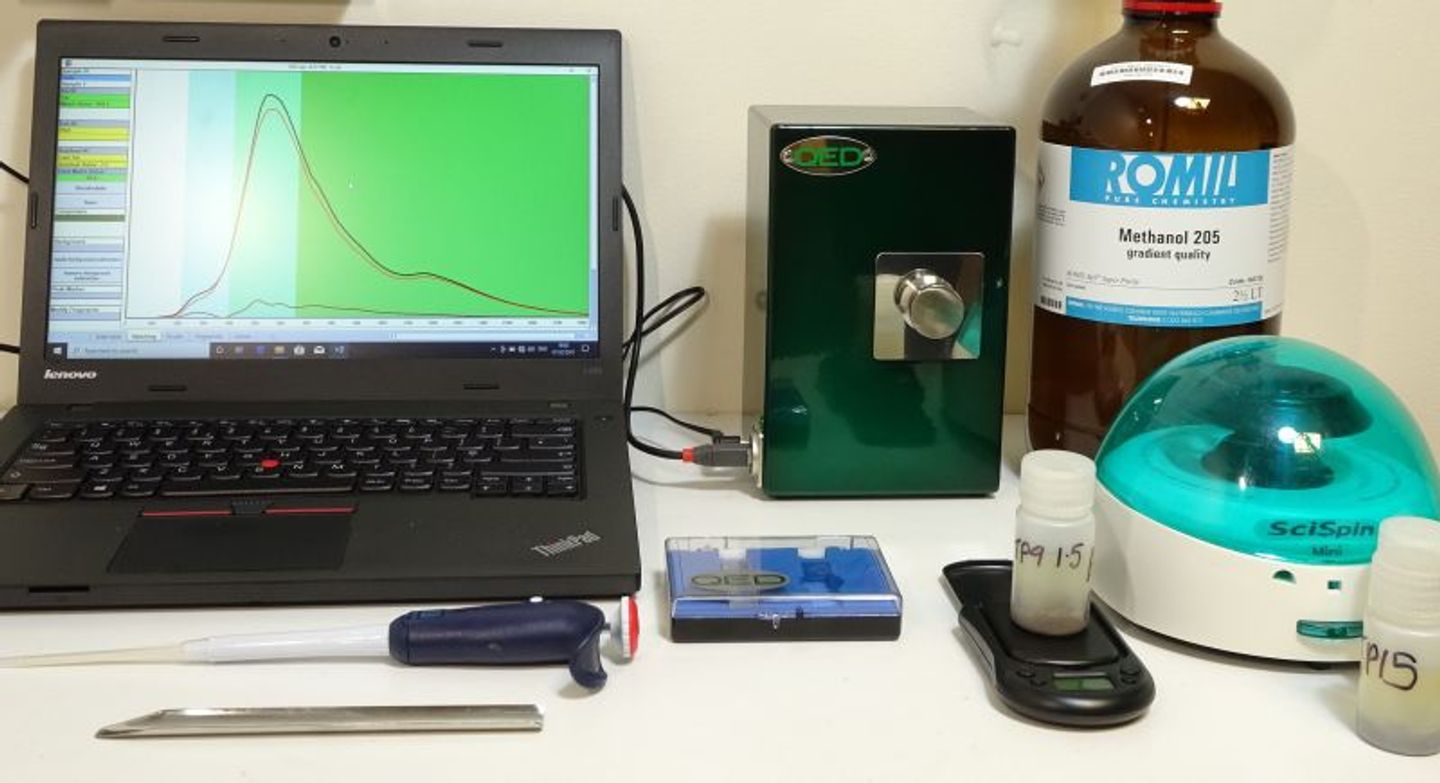
With respect to contaminated land or water the most common source of phenolic compounds encountered comes from creosote (derived either from wood or coal) or coal tar, by products of the gas production process used to produce heating and lighting gas to our towns and cities from 1760 to 1960s. The QED hydrocarbon analyser developed by QROS has the ability to quantify and differentiate between these two sources of creosote and coal tars, in both soil and water, with results in minutes.
Ammonium ions are generated by ammonia reacting with proton donors. When ammonia is dissolved in water, a significant amount of it reacts with the hydronium ions in water to give ammonium ions. Ammonia contamination is often historic in nature and often found on old coal carbonisation plant sites.
QROS offer an on-site technique that allows us to quantify the level of exchangeable ammonium in soil within approximately 20 minutes. The method is suitable for soil and water samples.
Also available are on-site techniques for the determination of soluble sulphate and soluble.
Most cyanide contaminated sites are due to the historic use of the land for gas production with cyanide present in both free and complexed forms. In order to remove impurities such as hydrogen sulphide, carbon dioxide and hydrogen cyanide from the generated gas, it was passed through ferric oxide forming ‘blue billy’. ‘Spent’ oxide was then often disposed of on-site.
Cyanides can also be found in old print works where the deep blue pigment Prussian blue was used in the making of blueprints (left.) It is derived from iron-cyanide complexes (hence the name cyanide, from cyan – a shade of blue).
QROS offer a rapid on-site technique that is able to quantify soluble cyanide in approximately 20 minutes with detection limits down to 1 ppm.
Historically sulphur contaminated wastes originated primarily from the sour gas sweetening industry, though more recently gypsum based waste products such as plaster board have become more prevalent.
Careless disposal of sulphur containing wastes may result in acidification of both soil and groundwater and hence sulphate consequently is a contaminant of interest to waste acceptance facilities. Additionally, concrete structures in contact with the ground are adversely affected by high sulphate levels and hence the construction industry is also concerned with levels of this contaminant.QROS is more frequently being asked to determine water soluble sulphate on-site. Standard limits of quantification for water soluble sulphate are generally requested to be 650 ppm, well below the 1000 ppm limit for inert classification although lower limits can readily be achieved upon customer request.
Chloride is another contaminant that QROS frequently tests for on-site. The dominant source of contamination by chloride is rock salt from roadside stores or transfer stations, though there may be other sources such as historical contamination from PVC production facilities.
QROS are able to determine soluble chloride levels rapidly and easily on-site using a titrimetric method capable of determining down to 400 ppm, well below the inert classification of 800 ppm. Lower determination limits are achievable upon customer request.