Landfill Leachate Treatment
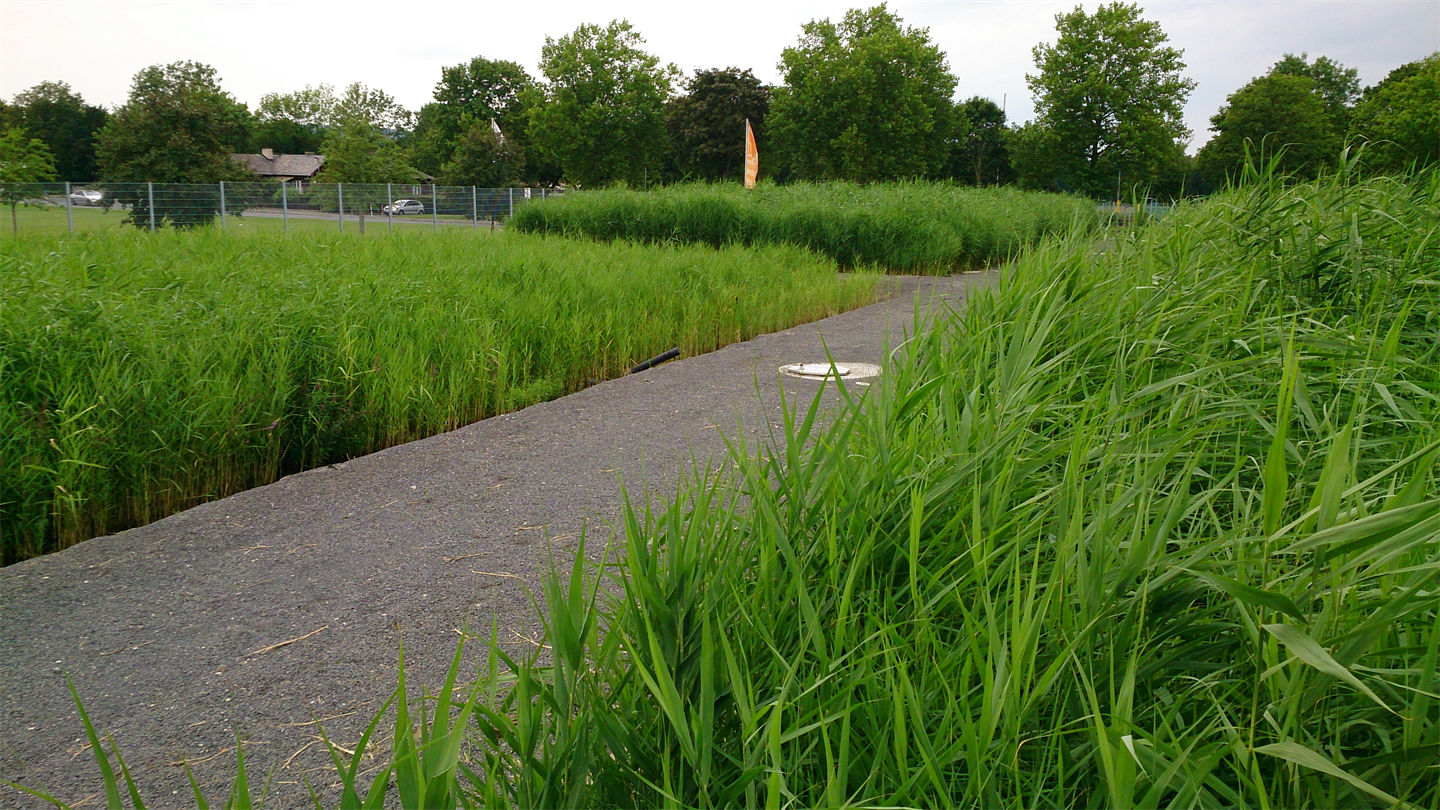
In the south-east of Hamburg, on the area of the depleted moor of Havighorst, surveyors in 1978 detected that major quantities of contaminated seepage water were leaking from the south-western boundary of a former construction waste dumping site (18 ha), which had been closed down and recultivated. Due to the bad smell it emanated, the seepage also had a negative impact on the local recreational area. In a move to solve this inherited problem, the leaking waters were captured and a constructed wetland system was built using the root zone method. This close-to-nature disposal concept, at the heart of which is a reed bed, was put into practise by the city of Hamburg in 1986.Description of the water treatment procedure
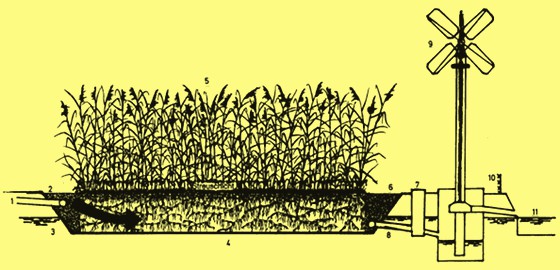
The constructed wetland of Hamburg-Havighorst consists of a synthetic membrane sealed reed bed which has a surface area of 2500 m2 and a depth of 60 cm. The collected seepage is supplied to the reed bed via a gravity pipe; discharge into the neighbouring circular ditch is provided by a wind power-operated lifting facility and an electrical pump.
Previous removal rates
The effluent of the Havighorst waste landfill differs from domestic sewage in many respects. For example, the biochemical (BOD5) and chemical (COD) oxygen demand is relatively low, and further reduced by root zone filtering by 60 - 70 % and 15 - 20 %, respectively. The low feed concentrations of nitrogen and phosphorus are also subject to significant further reduction (approx. 40 % of the nitrogen load and 25 % of the total phosphorus load).
The main problem substances in the landfill leachate are a number of chlorinated hydrocarbons (chlorbenzenes and chlorphenols) as well as specific aromatic hydrocarbons, in particular benzene, ethylene benzene and naphthalene. The conspicuously high concentrations of these persistent harmful substances are reduced by 94 - 100 % as they pass through the root zone.
The most troublesome substance in the heavy-metal fraction is arsenic which is present at a mean concentration of 29 µg/l (limit value for drinking water = 10 µg/l) in the landfill leachate. The mean value measured at the outlet of the planted soil filter is as low as 8 µg/l. Likewise, the mercury concentration of 0.9 µg/l (limit value for drinking water = 1 µg/l) has been reduced to 0.6 µg/l.