

Laser Diffraction Services
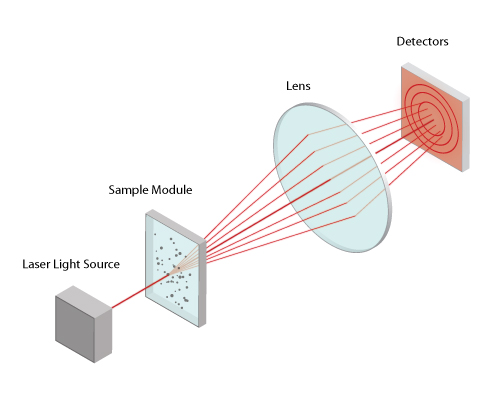
Laser Diffraction, also known as Static Light Scattering, has become one of the most widely used particle sizing distribution techniques across various industries. Samples can be analyzed on either a liquid suspension or dry dispersion basis. The sample material is passed through a laser beam which results in the laser light scattered at a wide range of angles. Detectors placed at fixed angles measure the intensity of light scattered at that position. A mathematical model (Mie or Fraunhoffer Theory) is then applied to generate a particle size distribution. The final result is reported on an Equivalent Spherical Diameter Volume basis.
Particle Size by Laser Diffraction is widely recognized by numerous standards and guidance agencies such as the ISO, ASTM, USP, EP and JP. This technique’s ability to perform dry or liquid dispersion analyses make it a good choice for general particle sizing applications and its broad dynamic range (submicron to millimeters) has proven useful to the environmental, pharmaceutical, food, health, beauty and many other industries.
A wide variety of sample types are applicable to analysis by Laser Diffraction including active pharmaceuticals (APIs), excipients, flyash, turbid wastewater, and environmental emission samples. Common applications include QA/QC batch testing, general survey screening measurements and comparative studies.