

- Home
- Companies
- Savante Offshore Services Ltd
- Services
- Savante - Mooring Chain Inspection ...
Savante - Mooring Chain Inspection Services
3D mooring chain integrity inspections represent one of the toughest subsea measurement challenges; regardless if delivered via ROV or by diver. Dynamics of both the chain catenary and the measurement platform are sensitive to environmental conditions; this can limit the window of operations particularly if the chain requires cleaning, the mounting of a calibration target or the use of a vernier-type caliper.
The precision, accuracy and resolution of a meaningful ‘digital twin’ must be better than +/-0.15mm to enable year-upon-year comparisons between successive campaigns and the identification of progressive wear and corrosion.
3D Scanners
Savante provides a complete range of measurement sensors for the delivery of high-integrity chain measurement results remotely or with an on-site surveyor. In this section we present a brief overview of the advantages, risks and limitations of each technique. For ROV based operations, these include both contact and contact-less systems including;
- 3DGP: Retrospective photogrammetry with scaled-object
- 3DGP: Monocular Vector HD photogrammetry and Scale-Board
- Contactless- Vergence: Stereo SLAM Photogrammetry and
- Contactless - DLS-350: 3D Laser SLAM mapping.
For diving operations we offer;
Monocular Photogrammetry
Monocular photogrammetry, delivered retrospectively or as a pre-planned operation with a calibration scale bar, represents the most reactive survey methodology for mooring chain system inspection. It can be delivered remotely often without the need to mobilise personnel or equipment.
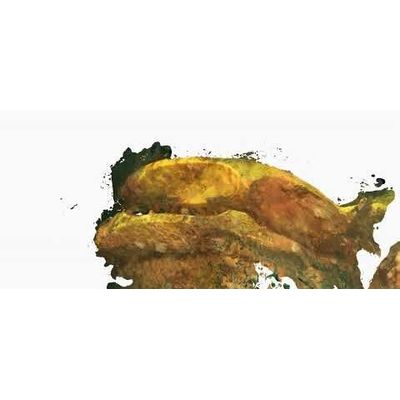
Prior to inspection, a calibration target must be rigidly mounted on the chain link of concern. A single HD camera or digital stills system, either ROV or diver held then collects footage of the mooring chain. The footage is then processed using our 3DGP processing system to create a 3D ‘digital-twin’ model.
For the inspection of large numbers of chain links, the requirement to install calibration targets on each link occurs on the vessel critical path; it is comparatively expensive, not as accurate as stereo SLAM, it is most sensitive to environmental conditions and creates the highest risk of damage to ROV manipulators or diver safety. In these instances, we recommend the use of stereo or laser scanning.
Stereo (and Higher Order) SLAM Scanning
Stereo (and higher order) optical SLAM scanning uses multiple optical sensors.different technology subsea laser scanners combine SLAM (self-localisation and mapping) technologies with our enhanced 3D measurement system to enhance the speed and accuracy of mooring chain integrity assessments. All that is required is for the ROV pilot to paint the mooring chain with the laser swath; the onboard electronics compensates for relative offsets and indexes each cross-section profile to a common datum. It is no longer necessary to directly physically connect with the mooring chain to determine measurements.
3D Laser SLAM
3D laser scanning provides the highest resolution 3D measurements and is also the most effective tool when inspecting chain links which are highly reflective.