


Relialytics - Oil Sample Report Analysis Services
Relialytics undertakes semi-automated oil sample data analysis to maximise the value our clients derive from oil sampling programs. Relialytics’ Equipment Condition Supervisor` (ECS) oil sample module utilises AI to interpret sample results and detect potential component failure modes and importantly lubrication degradation.
The system has been designed to minimise daily input from site engineers by:
- Directly addressing common/known issues, for example installation of wrong oils or external ingress in to compartments, by creating CMMS notifications / service requests.
- Directing key samples to the site engineer via a daily dashboard for examination before creation of notifications/service requests, placing on watch or discarding.
The ECS is designed to allow users to provide feedback on results using specific tags enabling continual improvement of the algorithms.
The ECS automatically examines daily oil sample data with the specific aim of providing consistency:
- Of analysis from sample to sample, component-to-component.
- In fluid use (i.e. the right fluids are being used for the compartment).
- In fluid quality (i.e. the fluid is free of contaminants).
- In service intervals.
In short, the ECS oil sample module takes the bulk of the sample review work out of the site engineer’s hands and ensures they only examine the samples that need to be examined.
Our aim is to improve your oil program quality such that 80% of your samples are reported as normal.
The following shows why we have designed this automated approach.
How Much Oil Sample Data Are We Producing?
The following chart shows a profile for the increase in oil sampling on a typical mine site over the past 20 years.
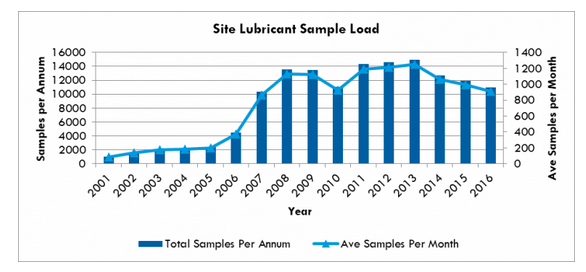
We are producing ever increasing amounts of oil sample data that should allow us to improve the reliability and productivity of our industrial equipment. However, are we using this data effectively?
The answer to this question is a resounding NO!
Relialytics’ consistent experience with new clients reveals that only 20% of oil sample data is utilised i.e. when a laboratory reports that a component has an issue that requires immediate action. The remaining 80% of the data, the data that allows us to identify and remediate poor oil conditions or identify emerging component issues, goes un–utilised.
If you only review 20% of your oil sample data, then your oil sampling program is of limited value – you are getting very little return for a significant investment.
Laboratories provide brief analysis reports and recommendations but rarely consider historical data trends.
The reports and recommendations are largely analyst dependent and can vary significantly from analyst to analyst. Reports are often generic (they don’t refer to specific issues) and are largely ignored by site personnel unless associated with a “call to action”.
As a result, many pre-cursor issues occurring prior to a “call to action” are missed, meaning that the call to action could not be avoided.
A single mine site produces approximately 6,000 oil samples per annum.
Assuming it takes an average 15 minutes to review each sample, a single engineer would spend 1,500 hours per annum undertaking sample analysis work. This is just not practical – even for the most experienced engineers.
An automated system that reviews all samples and determining which should be reviewed by the on-site engineers (including to criteria the engineers set themselves) is invaluable.