

- Home
- Companies
- Metawater Co., Ltd.
- Services
- Ozone Generation System
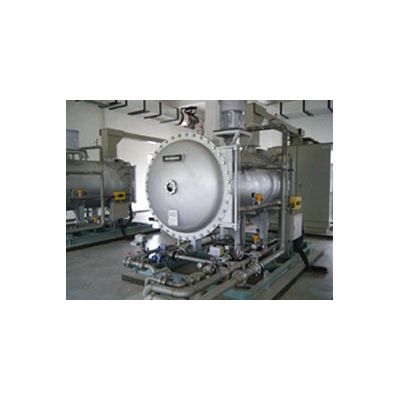
Ozone Generation System
The high reliability and proven performance of its products enable METAWATER to serve as a premium supplier of ozone systems and global multiple installations which can be used for a variety of applications.
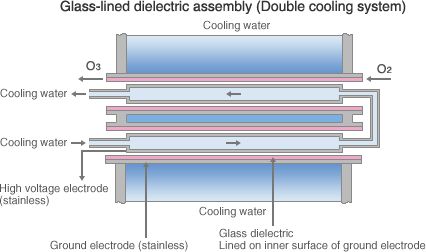
In order to generate ozone efficiently using the silent discharge technology, METAWATER offers highly accurate and ultra narrow discharge gap dielectrics with enhanced cooling system. Our Micro GapTM dielectrics, consisting of `Robust and Durable` glass lined stainless steel tube, permit the cooling of "Both the outer & inner dielectrics" by conditioned cooling water resulting in significant increase in the rate of heat removal, thus increasing ozone production performance.
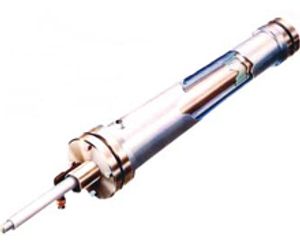
Configuration of Micro Gap Ozone Dielectric Assembly
METAWATER continues to adopt the long proven Micro Gap glass-lined dielectric core technology for our ozone generating equipment. The enhancement made over 20 years ago to include doubling cooling (for inner high voltage electrode cooling) remains unchanged. Recent enhancement to the Micro Gap core technology includes a further reduction in discharge gap resulting in power savings. Modification to the existing doubling cooling inlet and outlet arrangement provides unform forced water cooling of each high voltage electrode ensuring longevity of dielectric assembly.
Proven durability & reliability Micro Gap with state-of-the-art and experienced Power Supply equipment technology provides long haul and high quality ozone system. METAWATER brings "Easy operation and maintenance", "Low operating and maintenance cost" and "Excellent post-startup support and services" with requisite installation experience to all clients around the world.
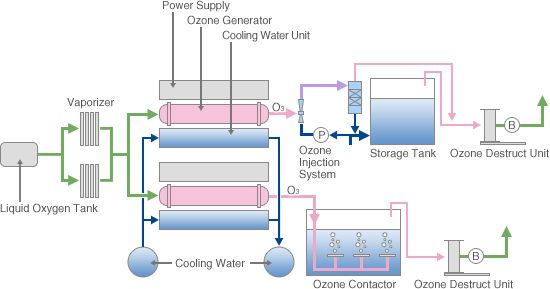
- Ozone generation system with different capacities available upon request.
- Standard specifications of the main power supply are 400/440/575 V.50/60 Hz.
- Oxygen concentration of the feed gas is assumed to be 90% or higher, with negligible hydrocarbons & dew point of loss then -60 deg C.