- Home
- Companies
- Hydro Resources, Inc.
- Services
- Sub-Surface Imaging Service
Sub-Surface Imaging Service
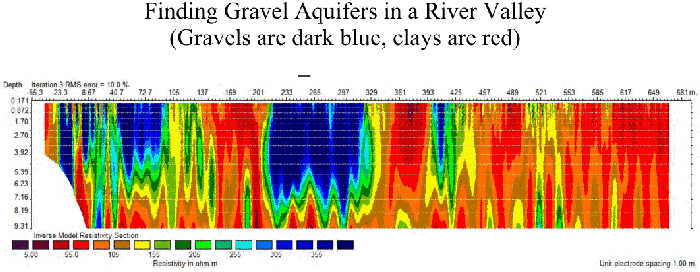
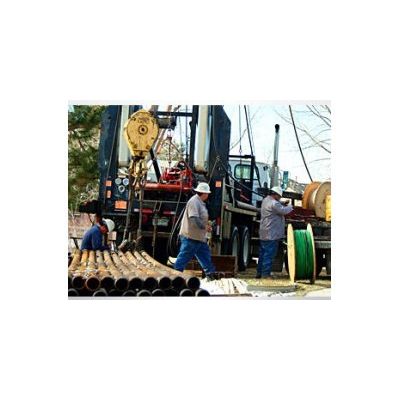
Hydro Resources offers a sub-surface resistivity imaging system which allows us to evaluate aquifers, alluvium, minerals and bedrock for numerous hydrological and geological purposes. This cutting-edge resistivity imaging and data interpretation process allows our clients a sub-surface view of the aquifer characteristics and water-bearing formations prior to specifying a specific drilling location.
By integrating the most sophisticated geophysical technologies available with the local geological conditions, we are able to isolate areas with the greatest groundwater production potential. Our imaging capabilities and services are also utilized in the energy, environmental and mineral industries.
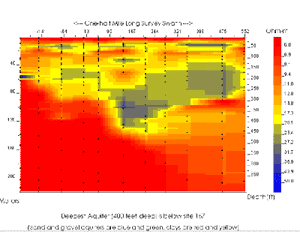
Our hybrid-source MT4 images the geological conditions below ground by utilizing a controlled-source transmitter and 4-dipole electrical/2-coil magnetic array. The geophysical terminology for the type of imaging we provide is High-Resolution Magnetotelluric Method, or MT. The MT method allows a subsurface resistivity view by measuring the ratio of the magnetic to electric fields, also called the impedance, at a set frequency. For a constant resisivity, this ratio is constant. Where there is a change in resistivity, the ratio is affected, and the new apparent resistivity can be determined.
When we transmit an electromagnetic set of frequencies (10 Hz to 100 kHZ) through our dual-loop antenna into the earth, we can capture the field re-emanations with our receiver array, measure the differential voltage between the two electrodes of each electrical dipole (tensor or scaler), amplify and filter the data with the Analog Front End and then send the data to the computer console for analog-to-digital conversion and digital signal processing. Finally, the data is then converted into 1D and 2D apparent resistivity views similar to a cross-section or fence diagram after the resistivity and depth-inversions have been calculated and saved.
Our standard MT4 geophysical system utilizes the natural low-frequency electromagnetic field (<70 kHz) where the depth of investigation is below the limit of our transmitter. The maximum depth of investigation by the MT4 is dependent upon the resistivity/conductivity of the earth and the available low frequencies in the project area. Should more detail and greater depth penetration be desired in zones below 450 m / ~1500 ft, a low frequency transmitter option is available with frequencies ranging from 0.1 Hz to 10 Hz.
The images produced provide information on zones with porosity and permeability, formation thickness, structure, facies change and lateral continuity. Because the weight of all equipment components combined is below 200 pounds, we can mobilize the equipment into areas that are inaccessible by vehicle. Our power sources are two rechargeable 12V batteries, enabling us to work globally.
Our hybrid-source MT4 images the geological conditions below ground by utilizing a controlled-source transmitter and 4-dipole electrical/2-coil magnetic array. The geophysical terminology for the type of imaging we provide is High-Resolution Magnetotelluric Method, or MT. The MT method allows a subsurface resistivity view by measuring the ratio of the magnetic to electric fields, also called the impedance, at a set frequency. For a constant resisivity, this ratio is constant. Where there is a change in resistivity, the ratio is affected, and the new apparent resistivity can be determined.
When we transmit an electromagnetic set of frequencies (10 Hz to 100 kHZ) through our dual-loop antenna into the earth, we can capture the field re-emanations with our receiver array, measure the differential voltage between the two electrodes of each electrical dipole (tensor or scaler), amplify and filter the data with the Analog Front End and then send the data to the computer console for analog-to-digital conversion and digital signal processing. Finally, the data is then converted into 1D and 2D apparent resistivity views similar to a cross-section or fence diagram after the resistivity and depth-inversions have been calculated and saved.
Our standard MT4 geophysical system utilizes the natural low-frequency electromagnetic field (<70 kHz) where the depth of investigation is below the limit of our transmitter. The maximum depth of investigation by the MT4 is dependent upon the resistivity/conductivity of the earth and the available low frequencies in the project area. Should more detail and greater depth penetration be desired in zones below 450 m / ~1500 ft, a low frequency transmitter option is available with frequencies ranging from 0.1 Hz to 10 Hz.
The images produced provide information on zones with porosity and permeability, formation thickness, structure, facies change and lateral continuity. Because the weight of all equipment components combined is below 200 pounds, we can mobilize the equipment into areas that are inaccessible by vehicle. Our power sources are two rechargeable 12V batteries, enabling us to work globally.
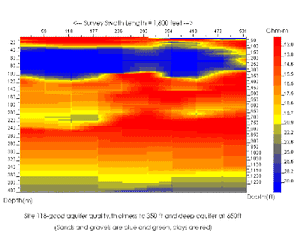
The MT2 is a capacitively coupled, dipole-dipole resistivity system. It transmits a 17 kHz frequency through a transmitting wire, inducing a current flow in the earth. Several receivers, or dipoles, matched to the transmitter frequencies are wired in tandem to measure the associated voltages between the dipoles. These voltages are converted to apparent resistivities and plotted versus depth to provide the final 2D plot.
The linear array is pulled along the ground either by a single person or attached to an all-terrain or 4WD vehicle. This towed-array allows for rapid data collection (10-25 times faster that a probe-resistivity surveys) to cover large survey areas. Due to its generated frequency there is no interference from other electrical sources. This allows for surveys close to and around power lines. By utilizing a capacitive electrode design, even areas with high contact resistance can be imaged. Data readings during each survey are taken twice per second while towing so that small features can be identified more easily. Two-dimensional or three-dimensional analyses are possible depending upon the goal of each project.
The MT2 is an excellent instrument for studying soil profiles, gravel or sand deposits, aquifer/groundwater exploration, mineral evaluation, environmental investigations, archaeological or engineering studies, soil contamination and cave/karst/void identification.